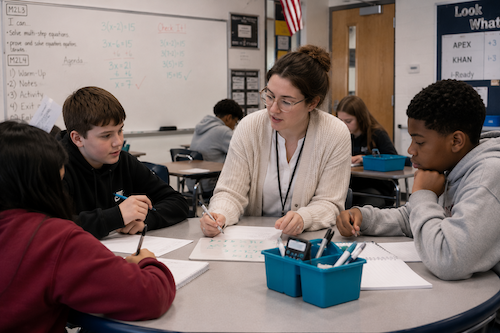
A high school math teacher's experience reveals a persistent weakness in American math instruction. Students master procedural steps but struggle to explain underlying concepts. This gap reflects a broader disconnect between how math gets taught in U.S. classrooms and what research shows actually works.
International classrooms, particularly in East Asian countries like Singapore and Japan, prioritize conceptual understanding alongside procedural fluency. These systems emphasize fewer topics taught in greater depth rather than racing through a broad curriculum. Teachers spend time on problem-solving strategies and helping students understand the "why" behind mathematical operations.
U.S. math instruction often reverses this priority. The typical American approach emphasizes speed and memorization. Teachers move quickly through content to cover state standards. Students learn formulas and steps without grasping the reasoning that makes those steps valid. Research from the National Assessment of Educational Progress (NAEP) consistently shows that American students lag in explaining mathematical reasoning, even when they reach correct answers.
Studies comparing classrooms internationally highlight what works. Japan's lesson study approach, where teachers collaboratively plan, teach, observe, and refine lessons, produces deeper learning outcomes. Singapore's math curriculum focuses on visual models and concrete-to-abstract progressions. Both systems allow students to develop mental math flexibility and transfer skills to unfamiliar problems.
Several U.S. school districts have adopted elements of these approaches. They've reduced curriculum scope, embedded more discussion and justification into lessons, and trained teachers in how to ask probing questions that push students beyond procedure. Early results show gains in both understanding and long-term retention.
The stakes matter. Students who understand mathematical concepts rather than just memorizing procedures perform better on college placement tests and complete remedial coursework at lower rates. They also report greater confidence and persistence when facing new problems.
Transforming math instruction requires changes to pacing guides, teacher professional development, and assessment practices. It means valuing student