# Summary
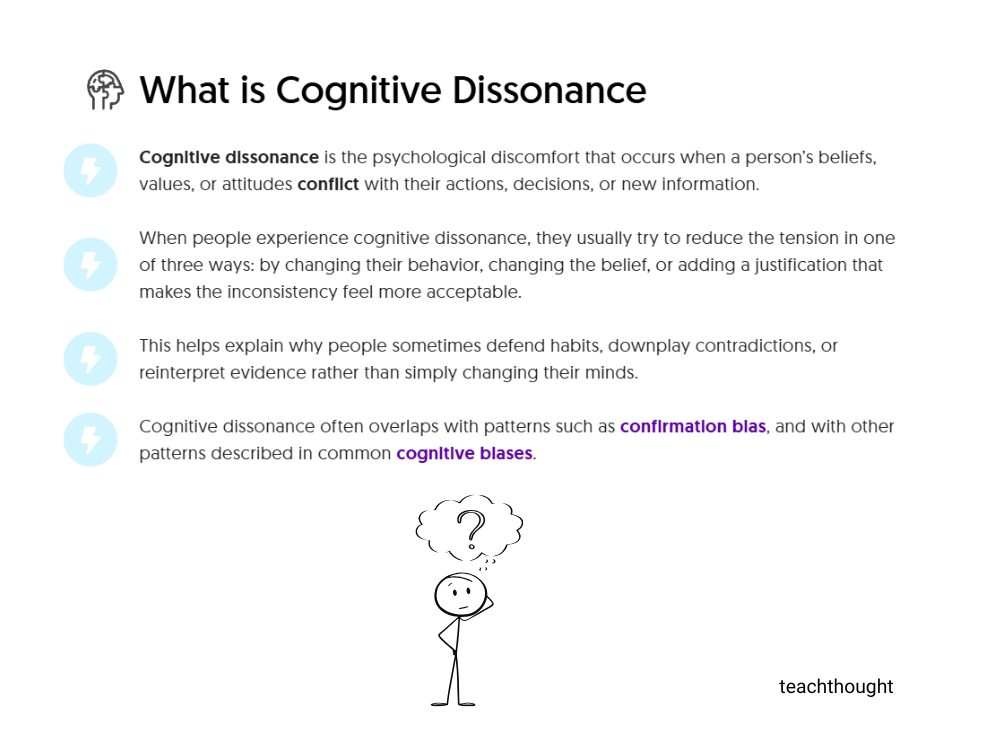
Cognitive dissonance occurs when people hold conflicting beliefs, values, or attitudes simultaneously, creating psychological discomfort. The concept, rooted in social psychology, describes the mental tension that arises when someone's actions contradict their stated values or when they encounter information that challenges their worldview.
For educators, understanding cognitive dissonance matters in the classroom. Students experience it when learning contradicts prior assumptions, when peers pressure them to behave against their values, or when they face evidence that conflicts with family beliefs. Teachers who recognize these moments can address them directly rather than dismiss student confusion or resistance.
The discomfort itself serves a function. People typically resolve cognitive dissonance through several pathways: they change their beliefs to align with behavior, change their behavior to match beliefs, or seek information that justifies holding both positions. A student who values honesty but copies homework faces cognitive dissonance. They might stop cheating, rationalize that "everyone does it," or convince themselves the homework wasn't really cheating.
Classroom applications are practical. When teachers introduce perspectives that challenge students' existing beliefs, they create cognitive dissonance. This discomfort, when managed well, drives deeper thinking and learning. A history lesson that presents multiple viewpoints on a historical event, or a science lesson that contradicts a common misconception, generates productive tension.
The key is scaffolding. Teachers who simply present contradictory information without support leave students stuck in discomfort. Effective instruction acknowledges the tension, validates it, and provides space for students to work through it. Discussion, evidence review, and reflection help students reorganize their thinking.
Classroom management also intersects with cognitive dissonance. When rules or expectations seem arbitrary or unfairly applied, students experience dissonance between what authority figures say and what they observe. Transparent reasoning behind classroom policies reduces this gap.
Understanding cognitive disson