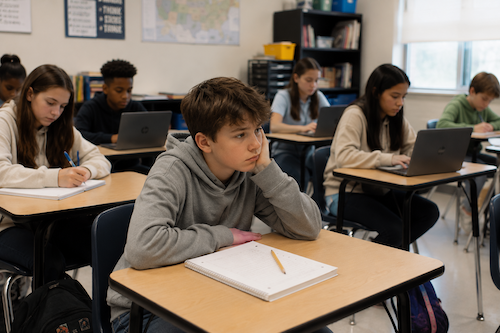
# Student Disengagement Spreads; Educators Shift Focus to Classroom Design
Educators across schools report a rising wave of student disengagement that exceeds pre-pandemic levels. Teachers describe students as increasingly difficult to reach, and the problem extends beyond typical behavioral issues.
Research and classroom observation suggest the root lies in how learning experiences are structured, not simply in student motivation or attention spans. When classrooms rely on traditional lecture formats, passive note-taking, and one-directional instruction, students tune out. This pattern accelerates when lessons feel disconnected from student interests or real-world application.
Schools responding to this trend are redesigning classroom environments and instructional methods. Successful approaches include project-based learning, peer collaboration, and personalized pathways that let students pursue questions that matter to them. Some districts integrate student choice into assignments, allowing learners to select topics or formats that align with their goals and interests.
Technology plays a supporting role. Digital tools enable teachers to deliver content more dynamically and track where individual students struggle in real time. However, tech alone does not solve disengagement. Overcrowded classrooms, limited prep time for teachers, and curricula packed with standardized test prep can still undermine student connection to learning.
The timing of this shift matters. Post-pandemic learning loss, mental health challenges, and screen fatigue have reshaped student readiness for traditional schooling. Teachers now navigate a student body with more varied attention patterns and higher anxiety levels than before 2020.
Districts investing in professional development help teachers learn facilitation techniques, trauma-informed practices, and strategies for building psychological safety in classrooms. When students feel heard and see relevance in their work, engagement typically follows.
The data suggests disengagement reflects a mismatch between how schools teach and how students learn best. Schools that experiment with flexible grouping, community-based projects, and student voice