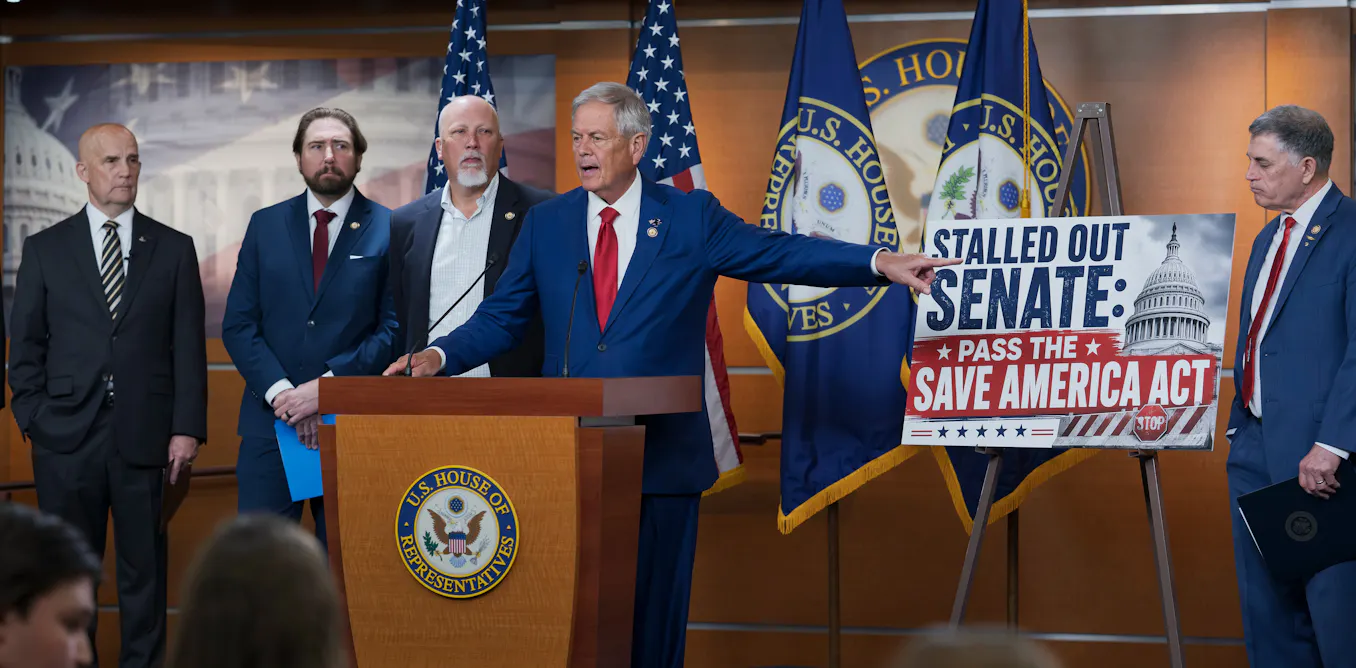
# Republicans Control Congress, but Trump's SAVE America Act Remains Stalled
Republicans control both the House and Senate, yet President Trump's SAVE America Act has not advanced into law despite public party support. The standstill reveals fractures within the GOP on voting restrictions and reveals how legislative process and competing priorities can block bills even with majority control.
The SAVE America Act targets mail-in voting procedures and implements strict voter identification requirements. These provisions align with Republican rhetoric on election integrity, and GOP leadership has expressed backing for the legislation. However, procedural hurdles and internal disagreements have prevented the bill from gaining traction on the congressional schedule.
A public policy and politics scholar points to several obstacles. First, Republican senators and representatives disagree on specific provisions. Some members worry strict ID laws could alienate moderate voters or face legal challenges from civil rights groups. Others prioritize different legislative items, from budget matters to judicial confirmations.
Second, the bill faces court vulnerability. Legal experts anticipate lawsuits challenging voter ID mandates and mail-in voting restrictions. Courts have previously blocked or modified aggressive voting restrictions in various states. Some Republicans hesitate to devote political capital to a bill that courts might overturn anyway.
Third, the Senate faces time constraints. With finite floor time, leadership must choose between competing priorities. Judicial confirmations, appropriations bills, and other executive-branch priorities compete for Senate calendar slots.
Fourth, Democratic opposition remains unified. Senate Democrats will use procedural tools to slow debate, requiring Republican unity to overcome filibusters. If even a handful of Republicans waffle on the bill's provisions, passage becomes difficult.
The stalled SAVE America Act demonstrates that legislative gridlock persists even when one party holds chambers. Majority control does not guarantee smooth passage of signature bills. Internal disagreement, constitutional concerns, competing legislative priorities, and parliamentary procedure all constrain what becomes law, regardless of