# Breaking Words Open for Meaning
A teacher discovered that phonetic decoding alone leaves students stranded. Students could sound out words fluently but had no idea what those words meant. This gap between pronunciation and comprehension reveals a widespread problem in literacy instruction.
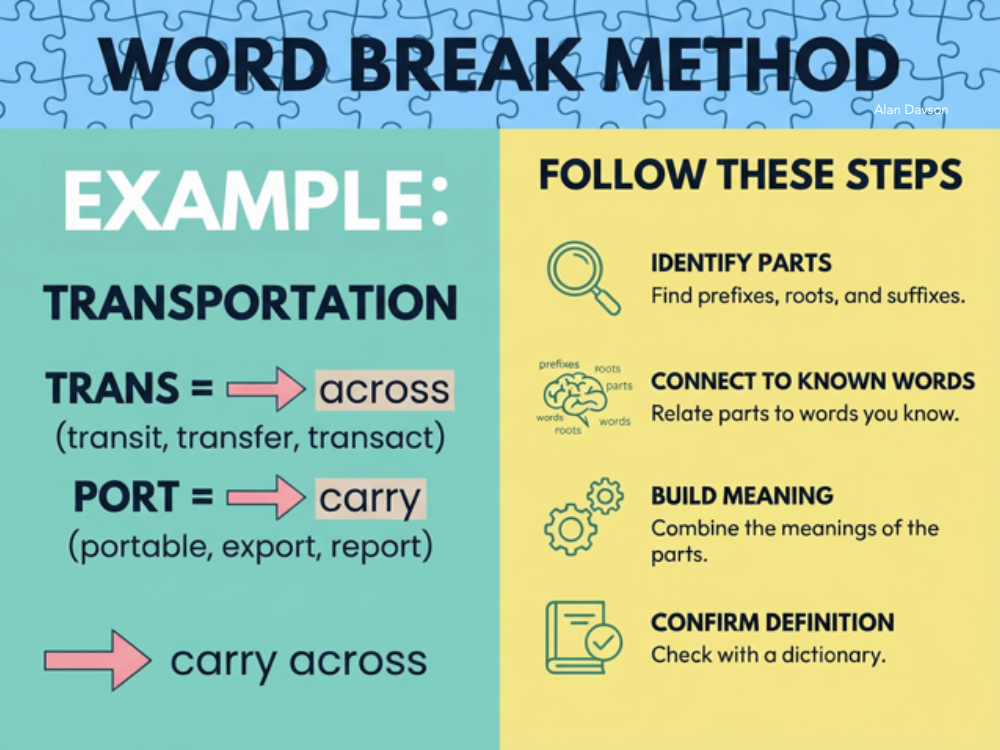
The strategy involves teaching students to break words into meaningful parts: prefixes, roots, and suffixes. When students learn that "un" means not, "happy" means a positive emotional state, and "ness" creates nouns, they can decode "unhappiness" and grasp its meaning without memorization.
This approach shifts instruction from mere sound-symbol correspondence to morphological awareness. Students who understand word structure become independent readers. They apply patterns to unfamiliar words. A student who knows "bio" means life and "logy" means study can approach "biology" with confidence, then move to "autobiography," "biography," and "biology."
The challenge surfaces in upper elementary and middle school, where vocabulary demands spike. Students encounter academic vocabulary in science, history, and mathematics. Phonics instruction typically ends by third grade, leaving many students without tools to unlock meaning in longer, more complex words.
Teachers report that morphological instruction works across proficiency levels. Struggling readers gain access to grade-level texts. Strong readers accelerate because they stop relying on context clues alone and understand how English builds meaning systematically.
Implementation requires explicit instruction. Teachers need time to model word decomposition, guide students through practice, and build a shared vocabulary of word parts. Schools that embed morphological instruction into their literacy blocks see students asking fewer "what does that mean?" questions and more "I figured out what that means" observations.
The takeaway for parents and educators: sounding out words matters, but understanding them matters more. Word structure instruction bridges that gap and builds readers who can tackle any text independently.