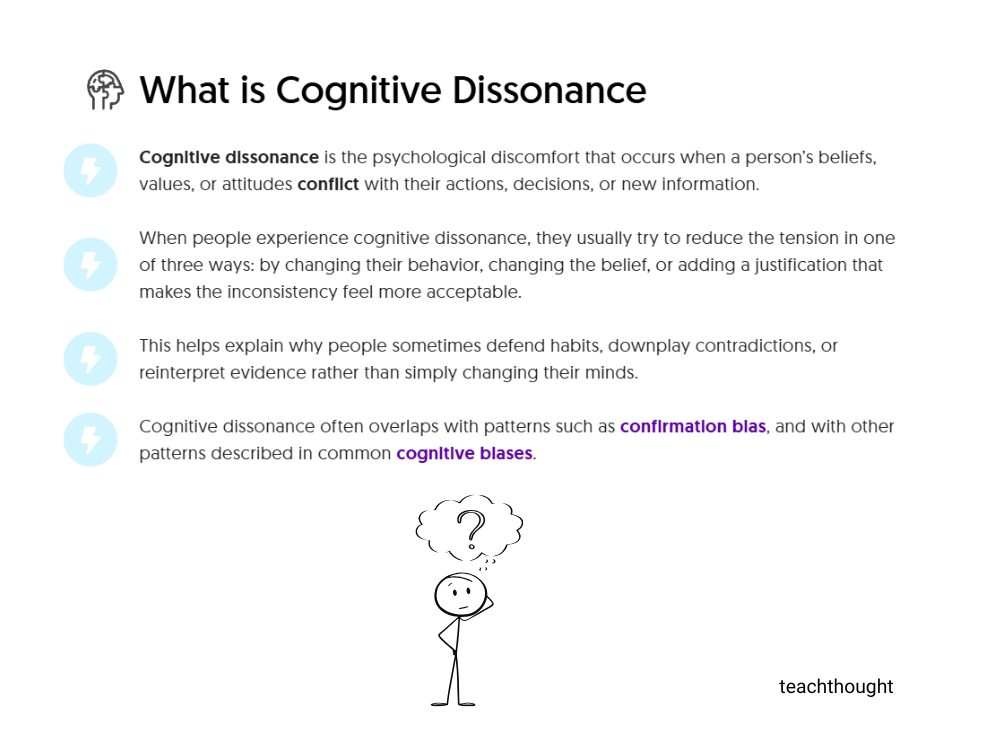
Cognitive dissonance describes the mental discomfort people experience when holding contradictory beliefs, values, or attitudes simultaneously. Psychologists define it as the gap between what someone believes and how they actually behave, or between two incompatible ideas they hold at once.
A student might experience cognitive dissonance if they value education but skip classes regularly. An educator might feel it when believing all students can succeed while doubting a particular student's abilities. These internal conflicts create psychological tension that people typically try to resolve.
Leon Festinger introduced cognitive dissonance theory in 1957. His research showed that people adopt several strategies to reduce this tension. They might change their behavior to match their beliefs, adjust their beliefs to justify their actions, or add new thoughts that bridge the gap between conflicting ideas.
In classrooms, understanding cognitive dissonance helps educators recognize why students resist learning certain material or why achievement gaps persist despite stated commitment to equity. When students encounter information that contradicts deeply held beliefs, they may reject the material rather than accept the discomfort of changing their worldview.
Teachers can use this concept productively. Presenting well-designed challenges that create mild cognitive dissonance pushes students to examine assumptions. However, excessive dissonance causes avoidance and shutdown. The key involves creating safe spaces where students feel comfortable reconsidering their positions.
Cognitive dissonance also explains teacher burnout. Educators often hold strong ideals about student potential and equitable instruction, yet face systemic barriers, limited resources, and policy constraints. This gap between aspiration and reality generates persistent discomfort that contributes to attrition.
Recognizing cognitive dissonance in both students and educators offers practical value. It explains resistance to change, helps predict which initiatives will face obstacles, and suggests that lasting shifts require addressing the underlying belief conflicts, not just imposing new policies or practices.
CATEGORY