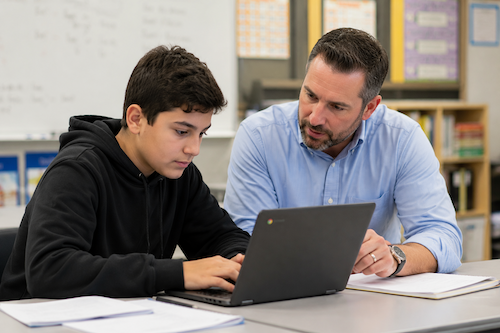
A high school teacher warns that artificial intelligence cannot replace the human relationships essential to effective instruction. The educator, reflecting on recent student conferences, argues that AI-generated feedback lacks the personal connection students need to feel seen and understood by their teachers.
The teacher's concern centers on a fundamental gap in automated systems. While AI can deliver technically accurate responses and identify errors quickly, it cannot engage in the dialogue that builds trust between teacher and student. Students require teachers who know their learning patterns, recognize their effort, and adjust instruction based on individual needs and context that only humans can fully grasp.
The debate over AI in classrooms has intensified as schools adopt chatbots and automated grading systems to manage workload. Districts see efficiency gains. Teachers see something different. They observe students receiving generic critiques that offer no path forward, no encouragement tailored to their specific struggle, no recognition of growth.
This teacher's perspective reflects broader concerns among educators about over-reliance on technology. While AI tools can handle routine administrative tasks, the core work of teaching remains irreducibly human. A struggling student needs more than a correction. They need someone who has watched them work, knows what they're capable of, and believes in their potential.
The argument does not dismiss AI entirely. Technology can grade multiple-choice assessments, flag plagiarism, or suggest resources. But these support roles differ fundamentally from feedback that shapes how students see themselves as learners. That work requires presence, judgment, and genuine relationship.
Schools implementing AI systems face a choice. They can use technology to free teachers from grunt work, creating space for deeper student interaction. Or they can deploy AI as a substitute for teaching, cutting costs while eroding the connections that make learning possible. The teacher's warning suggests many schools have chosen the latter path, outsourcing the very interactions that students remember most.