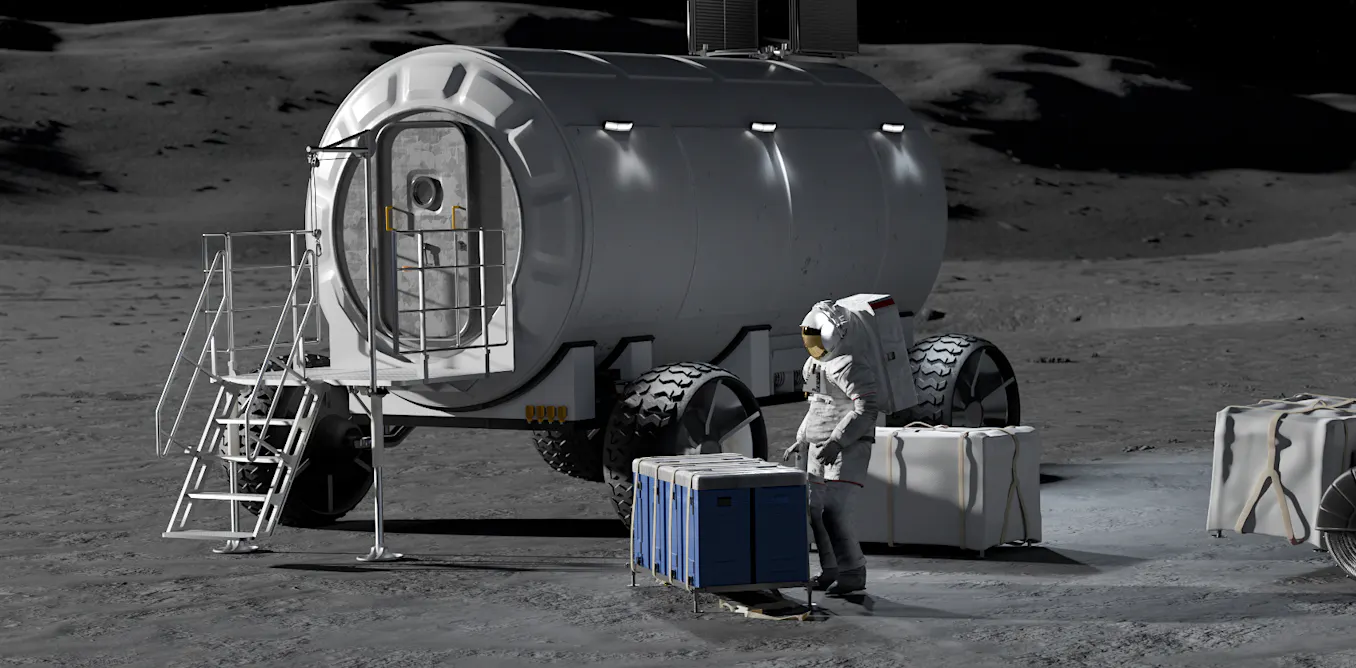
# Why the US-China Moon Race Could Turn Into a Lunar Land Grab
The competition between the United States and China to establish human presence on the moon's south pole is intensifying, with real stakes tied to resource scarcity and territorial claims. Both nations have announced plans to build permanent lunar bases in the coming decade, targeting the same resource-rich region.
The south pole matters because it contains water ice deposits in permanently shadowed craters, essential for sustaining human missions and producing fuel and oxygen. Only a handful of these optimal locations exist. China's Chang'e program aims to establish a research station by 2029, while NASA's Artemis program targets a similar timeline for establishing human outposts. This convergence creates a potential flashpoint for competition over finite real estate.
No international framework currently governs territorial claims on the moon. The 1967 Outer Space Treaty prohibits nations from claiming sovereignty over celestial bodies, but it contains no enforcement mechanisms for resource extraction or exclusive use of prime locations. Both countries operate within legal gray areas. A nation that establishes infrastructure first at a desirable site may gain de facto control, even without formal ownership rights.
The situation differs from Cold War space competition. Earlier efforts were largely symbolic. Today's lunar ambitions carry economic value. Water ice enables lower-cost deep-space missions, asteroid mining operations, and potential commercial ventures. Companies from both nations view the moon as a staging ground for future space industry.
Experts warn that without updated international agreements, the south pole could become congested with competing infrastructure, creating collision hazards and resource conflicts. The United Nations Office for Outer Space Affairs has proposed guidelines, but adoption remains unclear.
For educators and students, this competition illustrates how scientific progress intersects with geopolitics and resource management. The lunar south pole represents humanity's next frontier, but governance structures lag behind technological ambition. How nations resolve competing