# An Updated Guide To Questioning In The Classroom
Teachers who ask purposeful questions unlock deeper learning than those who rely on lectures alone. The ability to ask the right question at the right time serves as a reliable measure of whether students have truly grasped material, not simply memorized it.
Effective classroom questioning operates on a spectrum. Lower-order questions check basic recall: "What is photosynthesis?" Higher-order questions push critical thinking: "Why might photosynthesis be essential to life on Earth?" Research from cognitive science shows that mixing both types—not skipping foundational knowledge—produces stronger retention and transfer.
Timing matters enormously. Questions posed during instruction help teachers gauge understanding in real time and adjust pacing accordingly. Questions at lesson's end solidify learning and reveal gaps. Questions at the start of new units activate prior knowledge, linking new content to what students already know.
The physical act of asking questions shapes classroom dynamics. Wait time—the pause after posing a question before expecting an answer—typically runs only one second in most classrooms. Extending it to three to five seconds increases the number of students who participate, the length of their responses, and the confidence students show in their answers.
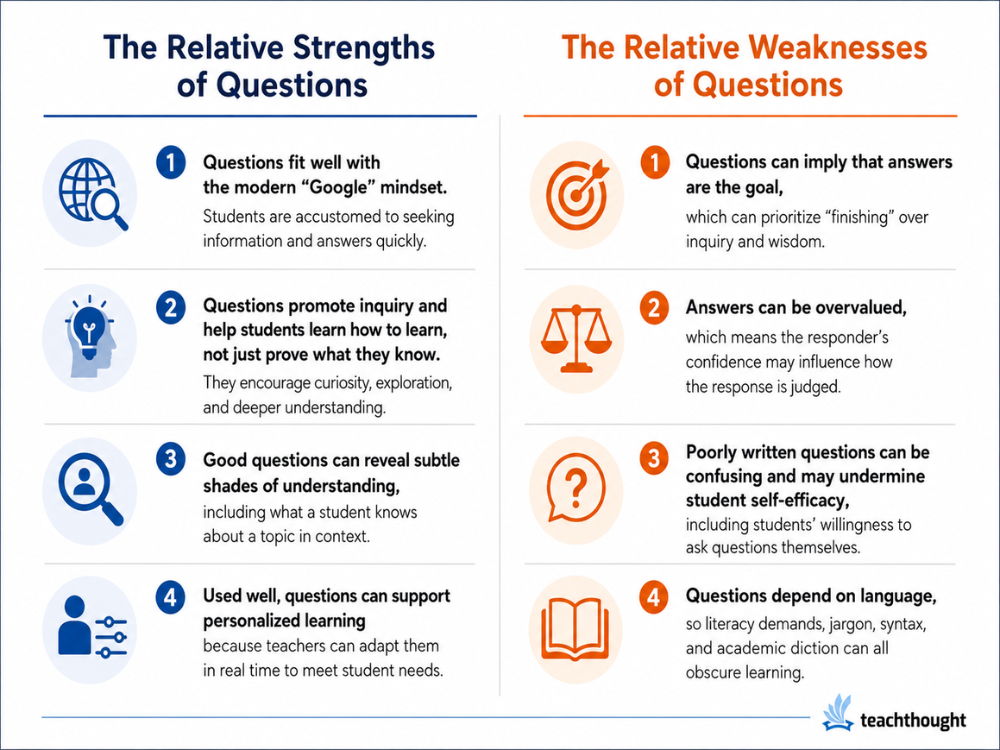
Question quality varies widely. Open-ended questions ("How would you solve this differently?") generate longer thinking than closed questions ("Is this right or wrong?"). Yet closed questions have their place in establishing baseline knowledge.
Modern classroom questioning also requires equity considerations. Teachers often unconsciously call on boys more frequently than girls, or on high-performing students while overlooking struggling learners. Randomizing who answers questions using name sticks or digital tools helps distribute participation fairly. Written responses before discussion allow quieter students to contribute without pressure.
Questioning techniques grounded in frameworks like Bloom's taxonomy help teachers intentionally move students from lower-order thinking toward analysis, evaluation, and creation. But frameworks alone fail