# How Breaking Words Changed the Way My Students Approach Language
A classroom strategy of decomposing words into their component parts has shifted how struggling readers engage with unfamiliar vocabulary.
The problem started simply. Students could decode words phonetically, sounding out syllables with reasonable accuracy. But when asked to define what they had just read, many went silent. The disconnect between pronunciation and comprehension revealed a gap in reading instruction.
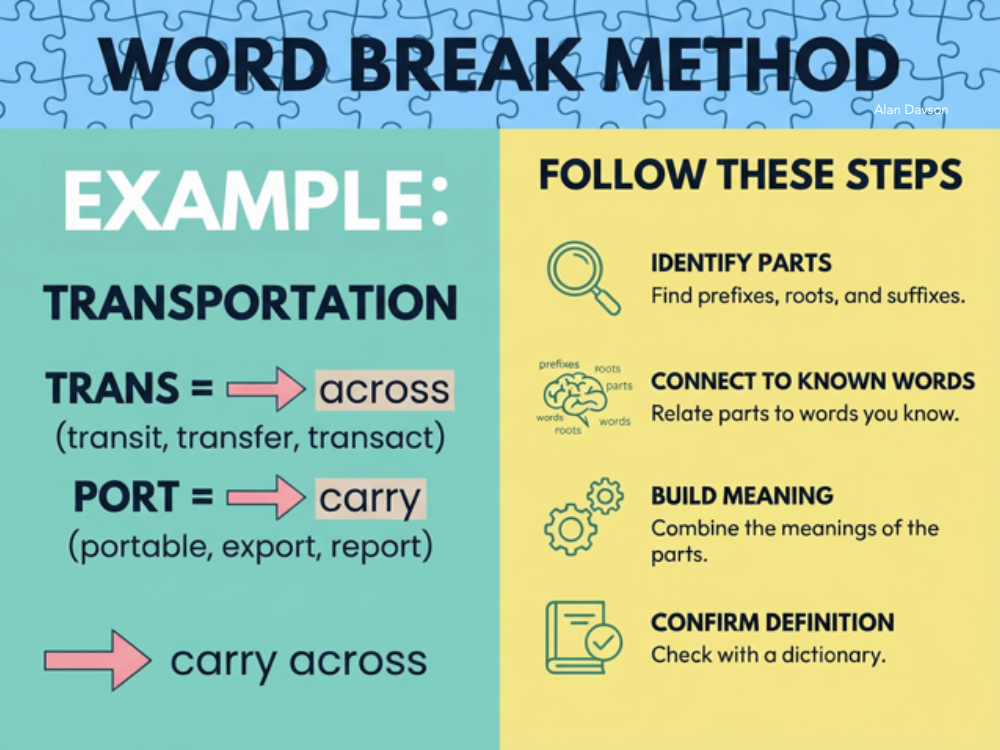
The teacher implemented a systematic approach to word analysis. Rather than treating words as monolithic units, students learned to identify prefixes, suffixes, and root words. This morphological awareness became a bridge between sounding out and understanding.
The strategy targets the reality that many English words share common components. Breaking "unhappily" into "un" plus "happy" plus "ly" allows students to infer meaning even if they have never encountered the full word before. This metalinguistic skill transfers across vocabulary learning.
The approach proved particularly effective for students who had memorized phonics rules but lacked deeper language structures. Instead of shutting down when confronted with complex vocabulary, students developed a problem-solving framework. They could ask themselves what each piece of the word contributed to overall meaning.
Teachers implementing this method report students becoming more confident readers. Rather than skipping unfamiliar words or asking for definitions, students attempt analysis independently. The shift moves reading from passive decoding to active comprehension building.
Word-breaking instruction aligns with research on how proficient readers tackle new vocabulary. Skilled readers naturally attend to morphological patterns. Explicit instruction in this process accelerates students toward independent reading strategies that work across grade levels and subject areas.
The strategy does not replace phonics or vocabulary instruction. Instead, it complements both by adding a layer of linguistic understanding. Students who previously felt powerless when encountering challenging text gained tools to wrestle with language independently.