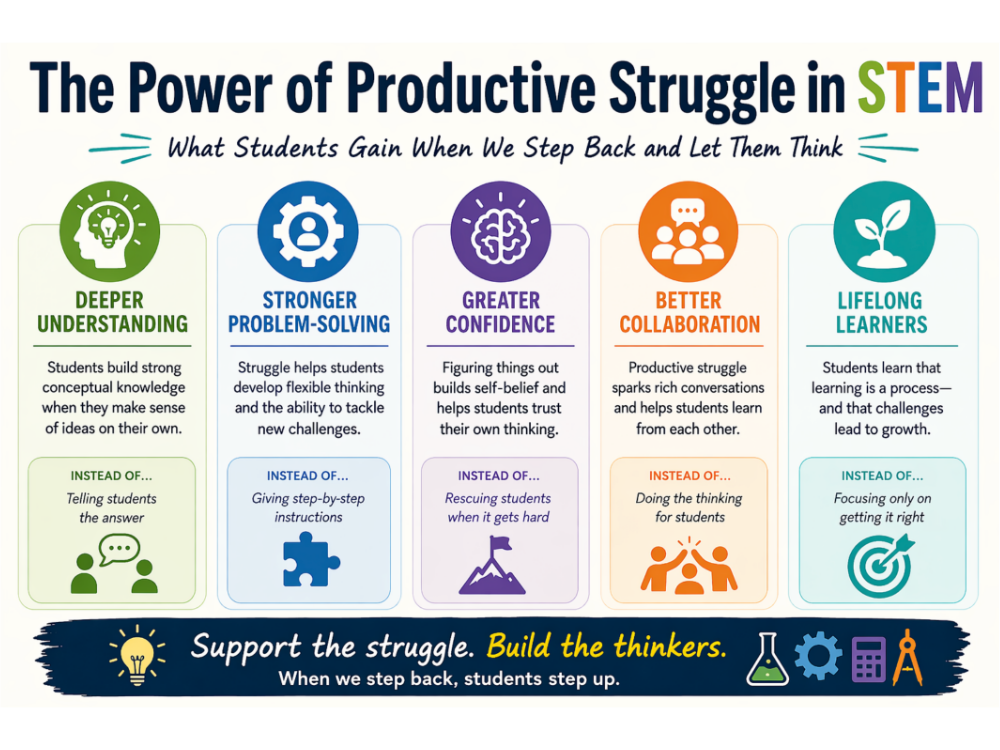
# When STEM Lessons Are Too Easy, Students Stop Thinking
Teachers often equate student engagement with learning, but new thinking on STEM instruction challenges that assumption. When lessons lack appropriate challenge, students disengage cognitively even while appearing busy.
The problem runs deeper than boredom. Easy STEM tasks allow students to complete work through memorization or surface-level procedures without activating the problem-solving and critical thinking skills these subjects demand. A student can finish a math worksheet or follow a lab protocol mechanically, checking boxes while their brain remains largely passive.
Research in cognitive science supports this counterintuitive finding. Learning requires struggle. When tasks align with student ability but stretch just beyond current performance, the brain engages in the productive difficulty necessary for growth. Neuroscientist David Yeager's work on mindset emphasizes that challenge signals opportunity for learning, not failure. Students who encounter appropriately difficult material and persist through it develop deeper understanding and stronger neural pathways than those coasting through easy work.
For STEM educators, this reshapes lesson design. Rather than asking "Will this keep students busy?" the question becomes "Will this push students to think?" A task that produces correct answers quickly may signal a need for increased complexity, not success.
Practical applications include presenting STEM problems without obvious procedures, requiring students to evaluate multiple solution paths, and asking them to defend their reasoning. Open-ended investigations where the path isn't predetermined generate more cognitive engagement than worksheets with predetermined steps.
The shift requires trust that students benefit from productive struggle and that slower completion rates with deeper thinking outweigh faster completion with shallow processing. It also demands differentiation. One group's appropriate challenge differs from another's, requiring teachers to assess where each student operates and pitch instruction just beyond that level.
STEM instruction succeeds not when students stay busy, but when they think hard about problems that matter. Engagement without