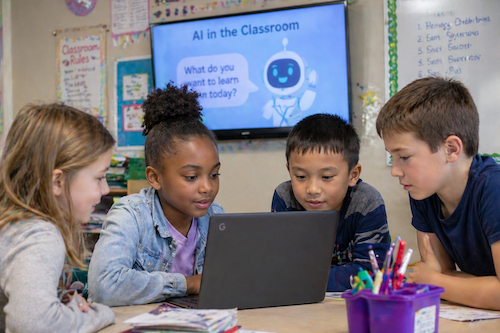
American schools lack consistent policies on artificial intelligence use, leaving individual teachers to make independent decisions about when and how to deploy the technology. This fragmented approach creates wildly different student experiences depending on classroom location and teacher preference.
Some educators integrate AI as a tutoring tool for personalized learning. Others ban it entirely, treating the technology as a threat to academic integrity. Many remain uncertain how to use it productively. The result: two students in the same school building receive fundamentally different instruction on AI literacy and application.
Schools have not established district-level or state-level guidance on AI adoption. Without clear frameworks, teachers operate in isolation. Some use AI writing assistants to help struggling writers improve drafts. Others prohibit students from touching any AI tool. A handful experiment with AI grading systems. Most have no formal training on the technology's educational potential or risks.
This inconsistency matters. Students need coherent exposure to AI literacy across grades and subjects. They also need clear academic integrity standards. If one teacher permits AI-generated essays while another fails them, students receive conflicting signals about the tool's appropriate use.
Teacher preparation programs largely ignore AI instruction. Universities do not systematically train future educators to evaluate AI tools or design lessons around them. Professional development in existing schools remains sparse. Teachers making AI decisions often lack expertise in the technology or pedagogy.
Schools face real constraints. AI tools cost money. Educators worry about data privacy and algorithmic bias. Some AI platforms target students but lack rigorous research on learning outcomes. These legitimate concerns deserve institutional attention, not piecemeal teacher responses.
Districts that have moved beyond ad-hoc adoption typically establish governance structures. They develop acceptable-use policies. They provide professional development. They set boundaries around data collection and algorithmic transparency. They treat AI as a system-wide challenge requiring shared decision-making.
Without such frameworks, schools cannot coherently prepare students for a world where