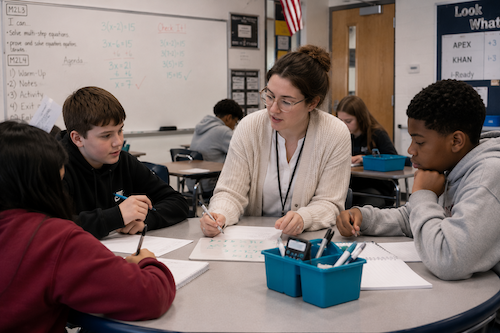
# What U.S. and International Classrooms Can Teach About Math Instruction
A student's inability to explain mathematical reasoning reveals a persistent gap in American math instruction. The anecdote captures a real problem: students master procedural steps without understanding the concepts underneath them.
Research comparing U.S. classrooms with international models, particularly those in East Asia and Europe, shows meaningful differences in how teachers approach mathematics instruction. Countries like Japan, Singapore, and Finland emphasize conceptual understanding before procedural fluency. Teachers in these systems spend more time on fewer topics, allowing deeper exploration. They use visual representations and real-world problems to anchor abstract ideas.
The contrast with typical U.S. practice is stark. American classrooms often rush through material, prioritizing the ability to execute algorithms over comprehension. Teachers cover more content annually but students retain less. Students memorize formulas and follow steps without grasping why those steps work or when to apply different methods.
Evidence from international assessments supports this difference. In the Trends in International Mathematics and Science Study (TIMSS), countries using conceptual-first approaches consistently outperform nations relying on procedural emphasis. Students in high-performing systems solve novel problems better because they understand the underlying logic.
The fix requires structural changes. Teachers need professional development focused on content knowledge and pedagogical techniques. Curriculum redesign must prioritize depth over breadth. Textbooks require revision to include more reasoning tasks and fewer procedural drills. Classroom time must shift from lecture-and-practice toward guided exploration and student explanation.
Implementation varies by district and school, but early adopters of conceptual instruction report gains. Students ask better questions. They catch their own errors. They transfer learning to new contexts.
The challenge lies in shifting educator mindsets and parent expectations. Some families worry that emphasizing understanding slows down computational speed. Schools must communicate that conceptual understanding actually