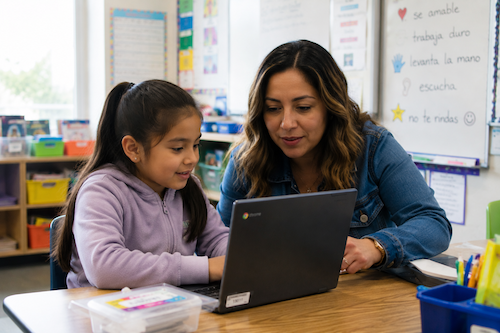
# Oracy Emerges as Critical Support for Multilingual Learners
Oracy—the ability to speak and listen effectively—addresses a fundamental gap in education for students learning in a non-native language. For multilingual learners, language functions as more than a subject; it becomes the vehicle for accessing all academic content and classroom participation.
Schools have historically emphasized reading and writing skills while neglecting spoken language development. This approach leaves multilingual students at a disadvantage. When students lack confidence in oral communication, they struggle to engage in discussions, ask questions, and demonstrate their understanding across subjects. Oracy instruction directly combats this problem by building speaking and listening competencies alongside literacy skills.
Embedding oracy into classrooms produces measurable shifts in student engagement. Teachers report that when oracy receives intentional focus, students transition from simply answering questions to reasoning through complex ideas. Students move from passive participation to active contribution. Perhaps most importantly, they move from silence to voice.
The approach benefits all learners, but multilingual students gain outsized advantages. Structured oracy work helps these students practice academic language in low-pressure settings. They develop vocabulary in context. They learn how to organize thoughts verbally before writing. They build confidence speaking with peers and teachers.
Schools implementing oracy programs create classrooms where talking is treated as serious academic work. Teachers provide explicit instruction in listening skills, turn-taking, and articulating ideas clearly. Students engage in structured discussions, debates, and presentations that require them to practice language in varied contexts.
Research suggests oracy-focused schools see improvements not only in language development but also in content learning across subjects. Mathematics, science, and social studies students perform better when they can discuss concepts verbally. Reading comprehension improves when students hear language used fluently and correctly.
For multilingual learners facing barriers in traditional classrooms, oracy instruction removes obstacles to academic success. It