# What Is Whataboutism?
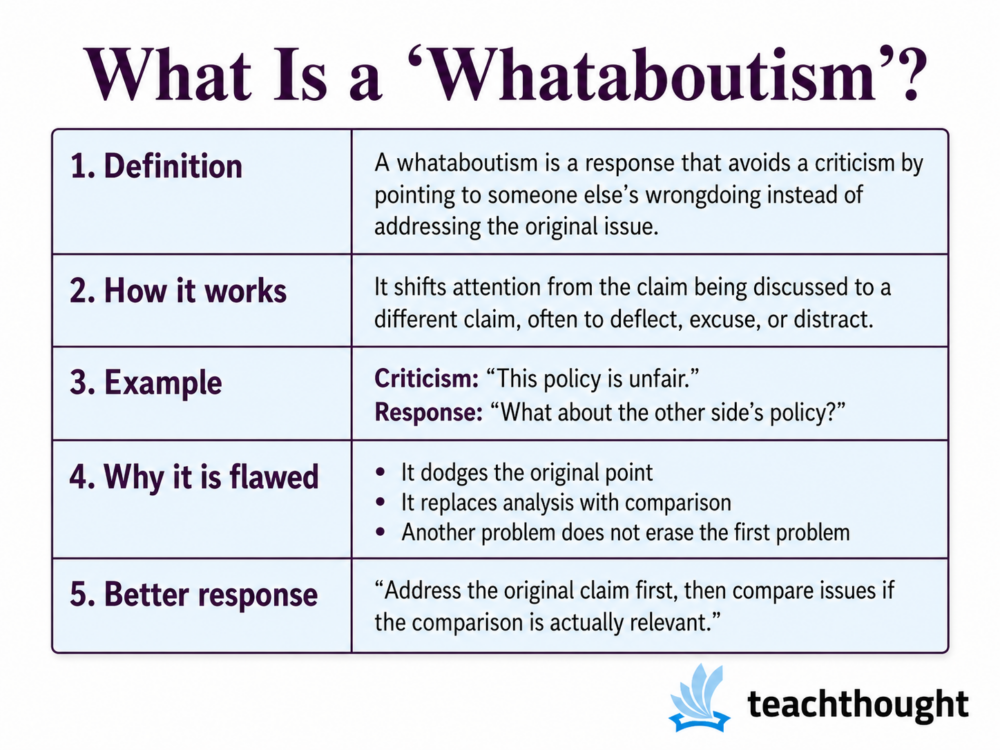
Whataboutism is a rhetorical strategy that deflects from a direct question or accusation by shifting focus to a different issue entirely. Instead of addressing the original claim, the person employing whataboutism responds with "what about" a separate problem, often one they view as equally or more serious.
The tactic serves a specific function. It avoids accountability by reframing the conversation. When someone asks why a policy failed, whataboutism responds by pointing to a failure in an opposing policy. When criticized for a particular action, it deflects by highlighting criticism of another group's actions.
Teachers and educators encounter whataboutism regularly in classroom discussions, social media debates, and public discourse about education itself. Students benefit from learning to recognize this pattern. The ability to spot deflection strengthens critical thinking and argument analysis.
In educational debates, whataboutism appears frequently. Critics of standardized testing sometimes face "what about charter schools?" responses. Advocates for inclusive curriculum encounter "what about teaching traditional values?" deflections. Both sides can employ the tactic.
The problem with whataboutism is structural. It prevents problem-solving. Two wrongs do not address either wrong. Identifying the tactic helps conversations stay focused on the actual issue at hand.
Schools increasingly teach students to recognize logical fallacies and rhetorical devices. Understanding whataboutism equips them to evaluate arguments more rigorously, whether in debates, essays, or civic participation. When someone deflects with whataboutism, naming it directly helps reset the conversation.
Educators teaching media literacy, argumentation, and civic discourse benefit from explicitly discussing whataboutism. Students who grasp this concept become more discerning consumers of information and stronger communicators themselves.