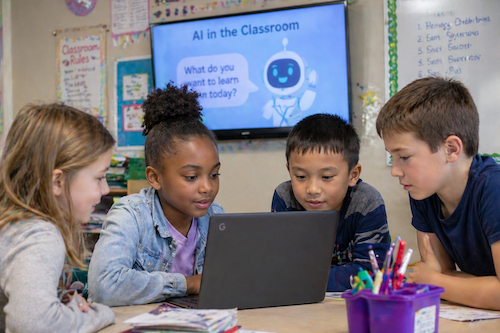
# When AI means something different in every classroom
Schools across the country lack consistent policies for artificial intelligence use, leaving individual teachers to make their own decisions about when and how to deploy AI tools. This fragmented approach creates wide variation in student experiences depending on which classroom they enter.
Without district-wide guidance, teachers rely on personal judgment about whether AI serves their pedagogy. Some incorporate AI writing assistants for drafting exercises. Others use it for personalized tutoring. Still others avoid the technology entirely. Students in the same school may have completely different relationships with AI based on their teacher's comfort level and understanding of the tools.
The absence of shared frameworks creates real problems. Teachers lack training on responsible AI use, data privacy concerns go unaddressed, and schools cannot evaluate whether AI is actually helping students learn. Districts have not established clear boundaries around academic integrity, equity, or transparency about how AI systems work.
Individual teacher autonomy has value. Teachers know their students and can adapt tools to specific learning needs. But autonomy without institutional support leaves educators isolated. It also raises equity questions. Students with teachers who have sought out AI training get different opportunities than those whose teachers have not.
Several districts have begun developing comprehensive policies. They are addressing plagiarism detection, bias in AI algorithms, student data protection, and professional development for teachers. These frameworks acknowledge AI's presence in schools while maintaining focus on learning outcomes rather than technology for its own sake.
The challenge now is scaling these efforts. Most districts still operate without formal AI policies. Teachers continue making ad hoc decisions. Students experience inconsistent exposure to and instruction about AI tools they will use throughout their lives.
Schools need clear structures that support teachers, protect student data, and ensure equitable access to AI's benefits. This requires district leadership, not just individual initiative. The goal is not to mandate uniform AI use but to create conditions where schools can implement these tools thoughtfully and transparently.