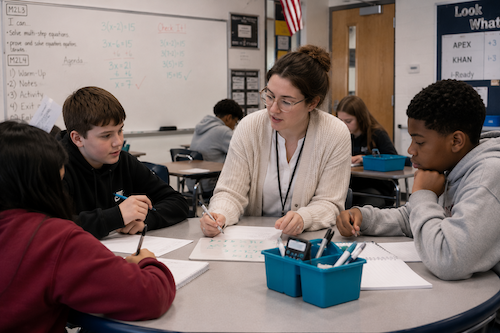
A mathematics teacher's experience reveals a persistent gap in American math instruction. Students often master procedural steps without understanding the reasoning behind them. This disconnect between procedural fluency and conceptual understanding represents a central challenge in U.S. classrooms.
Research comparing math instruction across countries shows that high-performing nations take different approaches. Countries like Japan, Singapore, and Finland emphasize deep conceptual understanding before moving to procedures. Teachers in these systems spend time explaining the "why" behind mathematical operations, not just the "how."
The contrast is stark. U.S. classrooms frequently prioritize speed and accuracy on procedural tasks. Students learn algorithms without grasping underlying mathematical principles. When they encounter unfamiliar problems or need to apply concepts in new contexts, they struggle because the foundation is hollow.
International classrooms demonstrate that slowing down initially pays dividends. Japanese lesson study practices, for instance, involve teachers collaboratively designing lessons that build understanding progressively. Singapore's model uses concrete-pictorial-abstract sequences, moving from physical objects to visual representations to abstract symbols. This scaffolding ensures students internalize concepts at each stage.
Several U.S. districts have adopted these international approaches with measurable results. Schools implementing problem-based learning and emphasis on mathematical reasoning report improved performance on both procedural and conceptual assessments. Students develop stronger problem-solving skills and maintain knowledge longer.
The shift requires changing how teachers are prepared and supported. Professional development must move beyond procedural training toward deepening teachers' own conceptual understanding. Lesson design time becomes essential, not optional.
Assessment practices also need restructuring. Tests emphasizing quick answers discourage the deeper thinking international models cultivate. Assessments incorporating open-ended problems and explanations better capture whether students truly understand mathematics.
For parents and educators, the lesson is clear. A student who can solve an equation but cannot explain why the method works lacks genuine mathematical understanding.