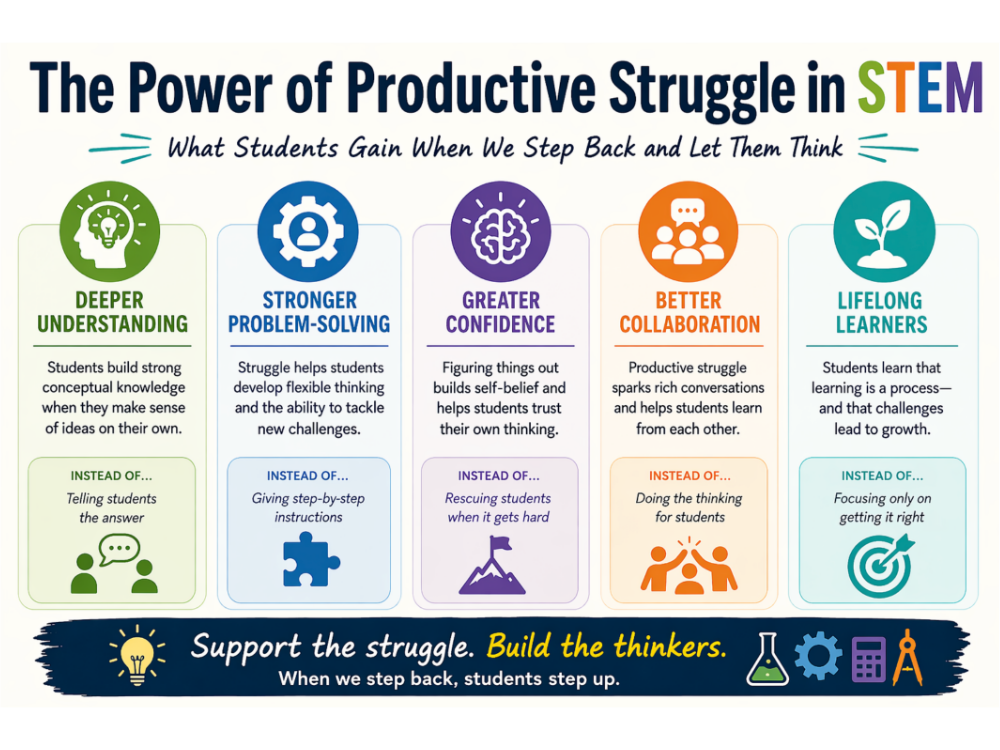
# When STEM Lessons Are Too Easy, Students Stop Thinking
Teachers often equate student engagement with learning, but research shows the two diverge when STEM lessons lack sufficient cognitive challenge. Students who breeze through material without struggle stop activating the deep thinking required for genuine mastery.
The problem stems from a common teaching strategy: keeping students occupied and seemingly "engaged" through accessible activities. While low-friction lessons maintain classroom momentum and positive attitudes, they bypass the cognitive load necessary for learning. When a math problem requires no real problem-solving, or a science experiment follows a scripted checklist, students complete tasks without processing concepts.
TeachThought highlights that STEM instruction often defaults to this shallow engagement model. Students move through activities, check boxes, and demonstrate surface-level competence. They may report enjoying class while retaining minimal understanding. Teachers mistake compliance and on-task behavior for actual learning.
The solution involves calibrating difficulty to each student's level. When tasks sit in what researchers call the "zone of proximal development," students encounter productive struggle. They work at the edge of their current ability, requiring genuine cognitive effort with appropriate scaffolding. A physics problem that demands multiple steps, a coding challenge with no single obvious solution, or a design task with constraints forces students to think, not merely execute.
This doesn't mean making STEM lessons arbitrarily hard. Rather, it means diagnosing where each student actually struggles and pitching instruction there. A student who finds basic algebra trivial needs different work than a peer still building foundational skills.
Teachers benefit from tools that provide real-time feedback on student thinking. Exit tickets revealing misconceptions, problem sets that expose gaps, and conversations about reasoning patterns help instructors identify the true difficulty sweet spot.
The takeaway reshapes how schools measure success. Busy students finishing assignments quickly may indicate instruction is too easy, not that learning is occurring. Effective