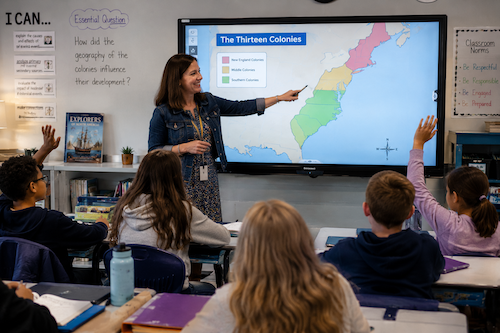
A Massachusetts fifth-grade teacher with 26 years in the classroom has built a teaching model centered on curiosity rather than rote memorization. Her approach transforms students into active researchers who question, debate, and connect historical content to their own lives.
The teacher rejected the traditional lecture-and-test format that made her dislike social studies as a student. Instead, she creates classroom conditions where fifth graders engage in historical arguments, develop their own questions, and treat inquiry as a core skill. This method treats research as a natural thinking process, not a separate assignment reserved for older grades.
The shift matters because elementary social studies instruction often prioritizes coverage over depth. Students memorize dates and facts but rarely develop the thinking patterns that drive actual research. By positioning curiosity as the engine of learning, teachers help younger students build habits of mind they will need in middle school, high school, and beyond.
Her classroom culture emphasizes student agency. Rather than accepting a textbook narrative, fifth graders examine sources, form interpretations, and defend their reasoning. This approach aligns with research on how children learn complex material. When students generate their own questions and pursue answers, retention improves and transfer to new contexts becomes easier.
The model also addresses a real problem in elementary education. Many schools compress social studies instruction to make room for math and reading. When social studies happens at all, it often lacks the intellectual rigor that keeps older students engaged. A curiosity-first approach reverses this. It shows that elementary social studies can be rigorous, active, and developmentally appropriate all at once.
This teacher's 26-year track record suggests the approach works. Her former students likely carried forward not just historical knowledge but also confidence in their ability to ask questions, find evidence, and think independently. That foundation shapes how students approach learning across all subjects and prepares them for the research demands of secondary education.