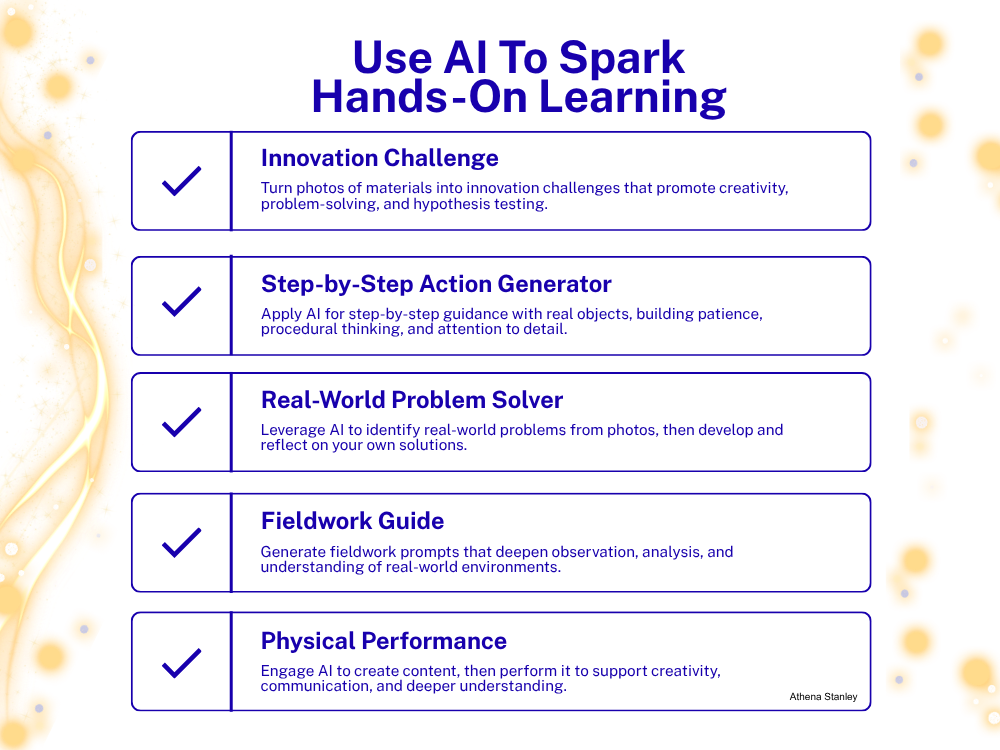
# From Screen to World: 5 Ways to Use AI to Spark Hands-On Learning in K–12 Classrooms
Educators are integrating artificial intelligence tools into K-12 classrooms to bridge digital learning with physical, real-world problem-solving. One emerging approach asks students to photograph their immediate surroundings—whether at school, home, or in their community—then use AI to identify environmental or social problems without receiving solutions from the tool.
This method shifts AI's role from answer-provider to question-generator. Students document issues through images, prompt the technology to analyze what they've captured, and then develop their own strategies for addressing identified problems. The approach combines observation skills with critical thinking while keeping hands-on action at the center of learning.
The strategy aligns with experiential learning theory, which emphasizes that students learn best through direct engagement with their environment rather than passive consumption. By starting with authentic local contexts—a pothole in a playground, poor lighting in a hallway, litter near a bus stop—students connect abstract classroom lessons to concrete community needs. They become investigators of their own spaces rather than consumers of pre-selected case studies.
Teachers implementing this method report that students move beyond identifying problems to proposing testable solutions. A student who photographs inadequate playground equipment doesn't just list issues; they sketch designs, calculate costs, and draft proposals to school administrators. Another student examining food waste in a cafeteria collects data, analyzes patterns, and presents findings to nutrition staff.
The AI component serves a specific purpose here. Rather than replacing student thinking, it accelerates the discovery phase. Students interact with the technology to expand their observations, then pivot to hands-on work—building prototypes, conducting surveys, presenting findings—where AI has no role.
This model works across subject areas. Science classes use it for environmental analysis. Social studies students identify community infrastructure gaps. Language