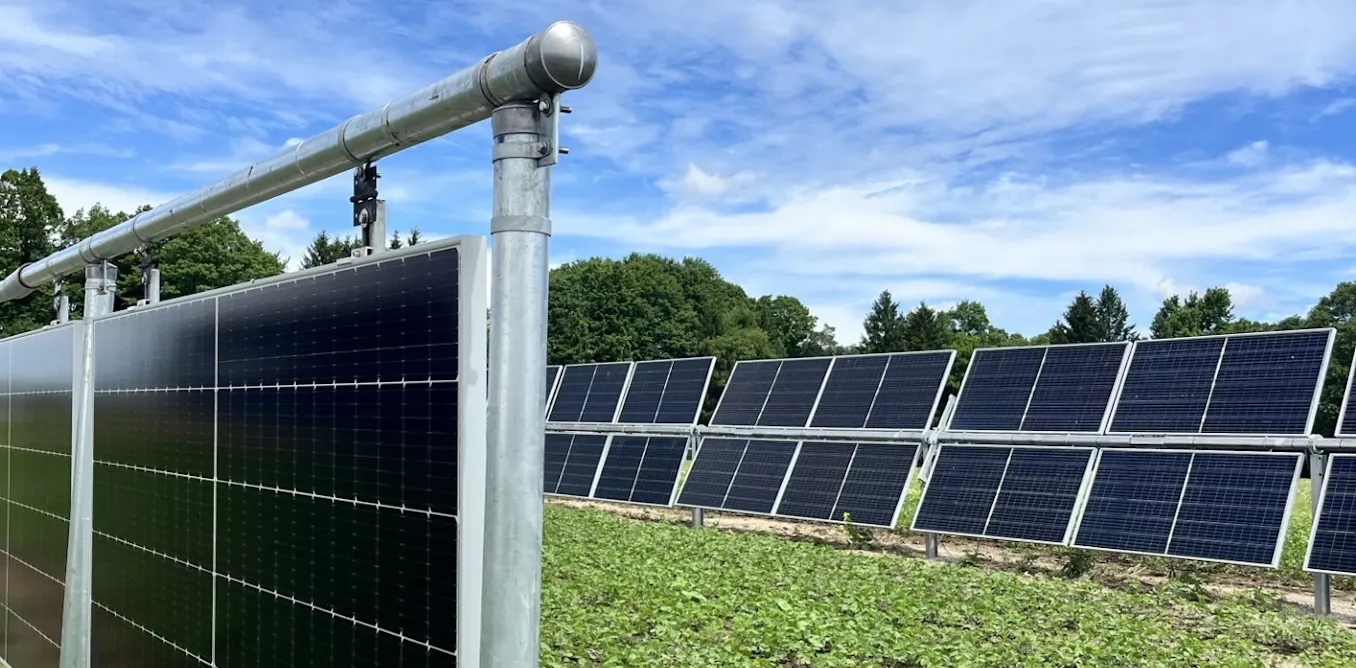
# Agrivoltaics Could Power AI Data Centers While Boosting Canadian Food Production
A new study demonstrates that agrivoltaics, the practice of combining solar energy generation with crop production on the same land, offers a dual benefit for Canada's energy and food systems. The research shows that agrivoltaic installations across Canadian agricultural land could generate sufficient electricity to eliminate fossil fuel dependence on the national power grid while requiring less than one percent of the country's total agricultural land.
The innovation addresses two pressing challenges simultaneously. Data centers powering artificial intelligence systems consume enormous amounts of electricity. Canada's grid currently relies on fossil fuels to meet peak demand. Meanwhile, agricultural sectors face pressure to improve sustainability practices.
Agrivoltaic systems work by installing solar panels at elevated heights above crops, allowing sunlight to reach plants below while generating power overhead. The configuration maintains crop yields while producing renewable energy. For Canada specifically, the research indicates that deploying agrivoltaics across a small fraction of existing farmland could meet the nation's total electricity needs without fossil fuels.
The study's findings carry particular weight given Canada's climate commitments and the rapid expansion of energy-intensive AI infrastructure. Tech companies operating data centers face mounting pressure to source clean electricity. Agrivoltaics offers these operators a pathway to carbon-neutral operations while supporting local agricultural economies.
Implementation challenges remain. Farmers require incentives to transition to agrivoltaic systems. Equipment costs, technological expertise, and regulatory frameworks must develop to support widespread adoption. Grid infrastructure also needs upgrades to handle distributed solar generation.
The research highlights an often-overlooked solution to competing land-use demands. Rather than choosing between food production and renewable energy generation, agrivoltaics enables both on shared land. For a country like Canada with substantial agricultural operations and growing data center development, this integration could reshape how the nation approaches energy independence while maintaining food security. Success