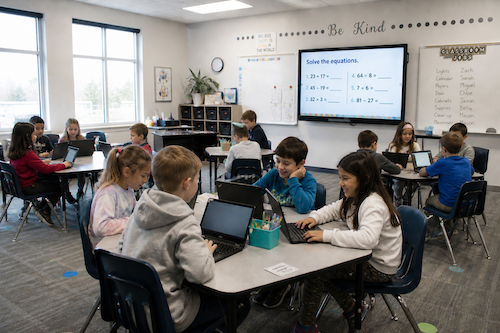
Many students struggle with math not because they lack ability, but because instruction misaligns with how brains actually learn mathematics.
Traditional math teaching follows a fixed sequence: introduce vocabulary, demonstrate procedures, assign practice. This approach works for some students but leaves others behind before meaningful learning begins.
Neuroscience research reveals that the brain learns math through different pathways than conventional instruction assumes. Students need to build conceptual understanding before memorizing procedures. When schools skip this foundational step and jump directly to algorithms and formulas, students without strong intuitive number sense lose confidence and disengage.
The problem compounds early. Students who struggle with foundational concepts in elementary grades carry those gaps into middle and high school, where math becomes increasingly abstract. By then, catching up requires reteaching entire conceptual frameworks, not just individual skills.
Effective math instruction aligns with cognitive science. Students benefit from concrete experiences before abstract symbols. They need to manipulate objects, visualize problems, and make connections between real-world scenarios and mathematical concepts. Only after building this mental foundation do procedures and vocabulary stick.
Teachers face real constraints. Crowded classrooms, standardized testing pressure, and curriculum pacing guides often force the vocabulary-procedure-practice sequence regardless of what neuroscience suggests. Professional development in brain-based learning remains limited and inconsistent across districts.
Schools taking a different approach report better outcomes. Districts that prioritize conceptual understanding, incorporate visual and kinesthetic learning, and allow flexible pacing see higher proficiency rates and stronger student confidence in mathematics.
The shift requires time, resources, and teacher training. It demands rethinking assessment, pacing guides, and textbook adoption. But the evidence suggests that when schools align math instruction with how students actually learn, more students succeed.