# When STEM Lessons Are Too Easy, Students Stop Thinking
The most engaged classroom is not always the most effective one. TeachThought reports that when STEM lessons lack sufficient challenge, students disengage from actual thinking, even while appearing busy.
Teachers often equate activity with learning. A student completing worksheets, running experiments, or building projects looks engaged. But engagement without cognitive demand produces surface-level work, not deep understanding. This matters in STEM, where conceptual reasoning separates students who truly grasp physics, biology, or engineering from those who simply follow procedures.
The problem intensifies in well-resourced schools where access to materials, technology, and sophisticated lab equipment can mask pedagogical gaps. Students may spend entire periods with robotics kits or coding platforms yet learn little about underlying principles. They execute steps without asking why those steps matter.
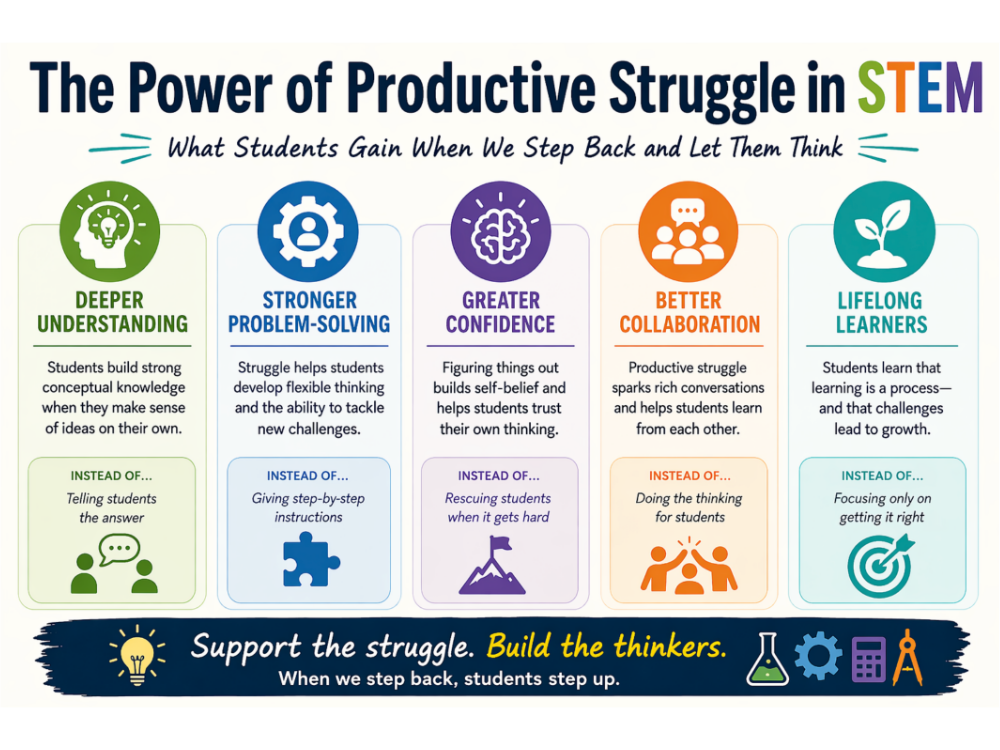
Research in cognitive science supports this finding. Struggle, productive struggle, drives learning. When tasks feel too easy, the brain allocates minimal resources. Students skim rather than analyze, copy rather than create, mimic rather than innovate.
Effective STEM instruction requires calibrated challenge. Tasks should sit just beyond what students can do independently, what educational psychologist Lev Vygotsky called the zone of proximal development. A well-designed lesson makes students uncomfortable enough to think hard but supported enough to succeed.
This reframes how teachers should view student frustration. Some resistance to a problem signals the cognitive demand is appropriate. Smooth, frictionless completion often signals the opposite.
The implication for curriculum design is clear. Adding more content, more projects, or more technology does not guarantee better learning. Instead, STEM educators must intentionally build lessons that require students to grapple with ideas, defend reasoning, and revise understanding. Engagement follows thinking, not the reverse.