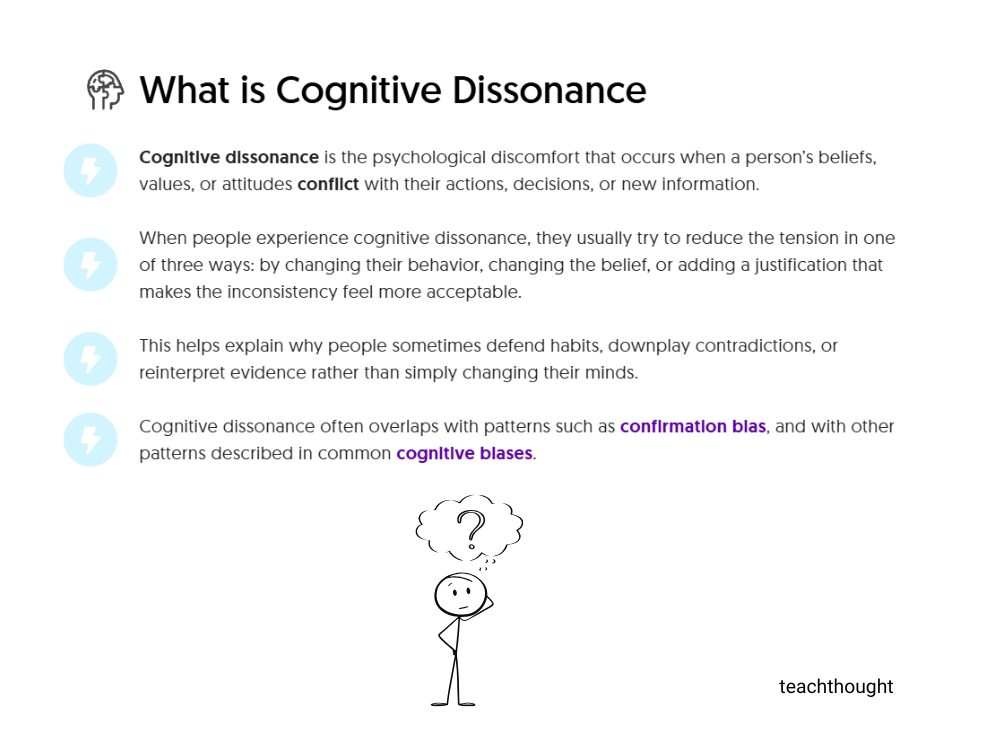
Cognitive dissonance describes the mental tension students and adults experience when holding contradictory beliefs simultaneously. A person might, for example, value environmental protection while driving a gas-intensive SUV. This psychological discomfort arises from the gap between attitudes and actions.
The concept matters in classrooms because it shapes how students learn and change their thinking. When students encounter information that conflicts with existing beliefs, cognitive dissonance activates. They must either adjust their beliefs, reject new information, or rationalize the contradiction. Understanding this process helps educators design lessons that effectively shift student understanding.
Leon Festinger developed the theory of cognitive dissonance in the 1950s. His research showed that people feel motivated to reduce this mental discomfort. They do this through three primary methods: changing their beliefs to match their behavior, changing their behavior to match beliefs, or adding new thoughts that bridge the gap between conflicting ideas.
In education, cognitive dissonance becomes a teaching tool. When instructors present evidence that contradicts student assumptions, productive dissonance occurs. A science teacher might challenge a student's belief that heavier objects fall faster by demonstrating that gravity affects all objects equally. The resulting discomfort motivates the student to revise their misconception.
However, dissonance can backfire. If the contradiction feels too extreme or the new information appears unreliable, students may dismiss it entirely. They might double down on incorrect beliefs instead of reconsidering them. Effective teaching balances cognitive challenge with support, giving students safe space to revise their thinking without feeling overwhelmed.
Teachers who recognize cognitive dissonance can leverage it strategically. Presenting evidence gradually, building trust, and validating student concerns helps learners sit with discomfort long enough to integrate new ideas. This approach works across subjects, from history to math to language arts.