# How Breaking Words Changed the Way My Students Approach Language
A teacher discovered that phonetic decoding alone leaves students stranded. Students who could sound out words phonetically hit a wall when asked to explain meaning, revealing a gap between word recognition and comprehension.
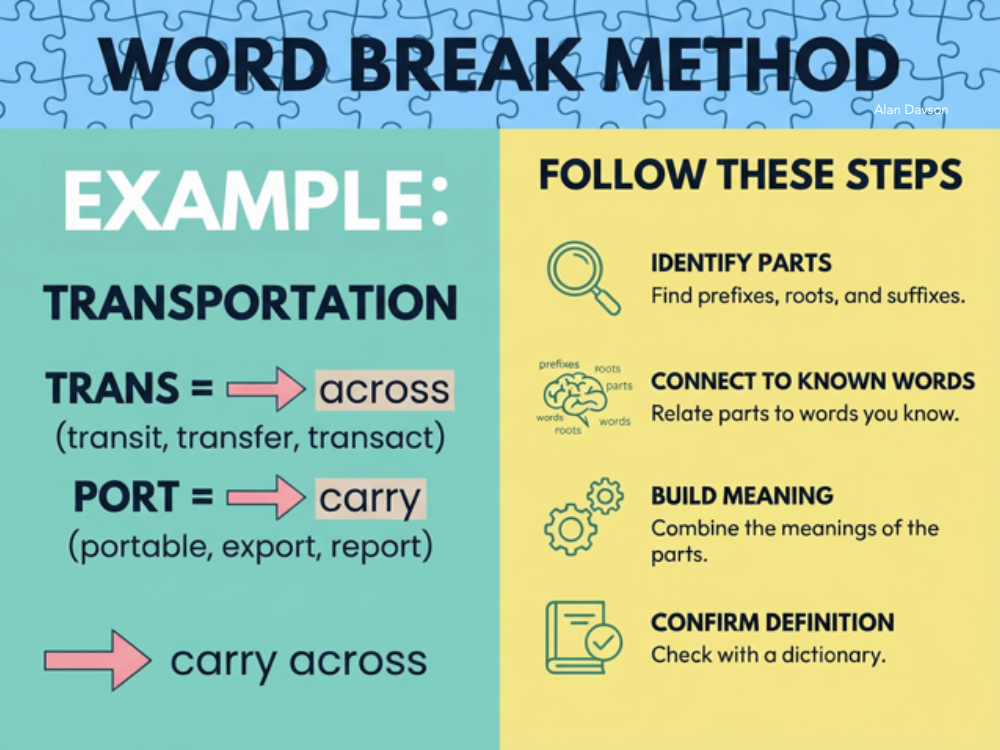
The strategy involves teaching morphology alongside phonics. Breaking words into roots, prefixes, and suffixes gives students multiple entry points into meaning. A student encountering "unhappiness" learns that "un-" negates, "happy" is the core, and "-ness" creates a noun. This structure reveals the word's meaning through its building blocks.
This approach transforms reading from a performance task into a detective activity. Students stop viewing unfamiliar words as obstacles and start analyzing them systematically. When they encounter "precaution" or "misunderstand," they apply the same decomposition strategy rather than guessing or giving up.
The teacher observed students becoming more confident readers. Word-solving became teachable. Rather than memorizing vocabulary lists or relying on context clues alone, students developed a portable toolkit. This matters because English contains thousands of morphologically related words. Understanding the morpheme structure of "construct," "deconstruct," "construction," and "constructive" simultaneously accelerates vocabulary growth.
Research supports this integration. Studies show that explicit morphological instruction improves both decoding fluency and comprehension, particularly for struggling readers and students learning English as an additional language. The National Reading Panel identified phonemic awareness, phonics, fluency, vocabulary, and comprehension as essential components of reading instruction. Morphology bridges phonics and meaning-making.
The classroom shift carries implications beyond reading class. Students who grasp morphological structure apply it in science (photosynthesis, organism) and social studies (government, democracy). They become independent word learners rather than dependent on teacher definitions.
Breaking words into parts requires explicit,