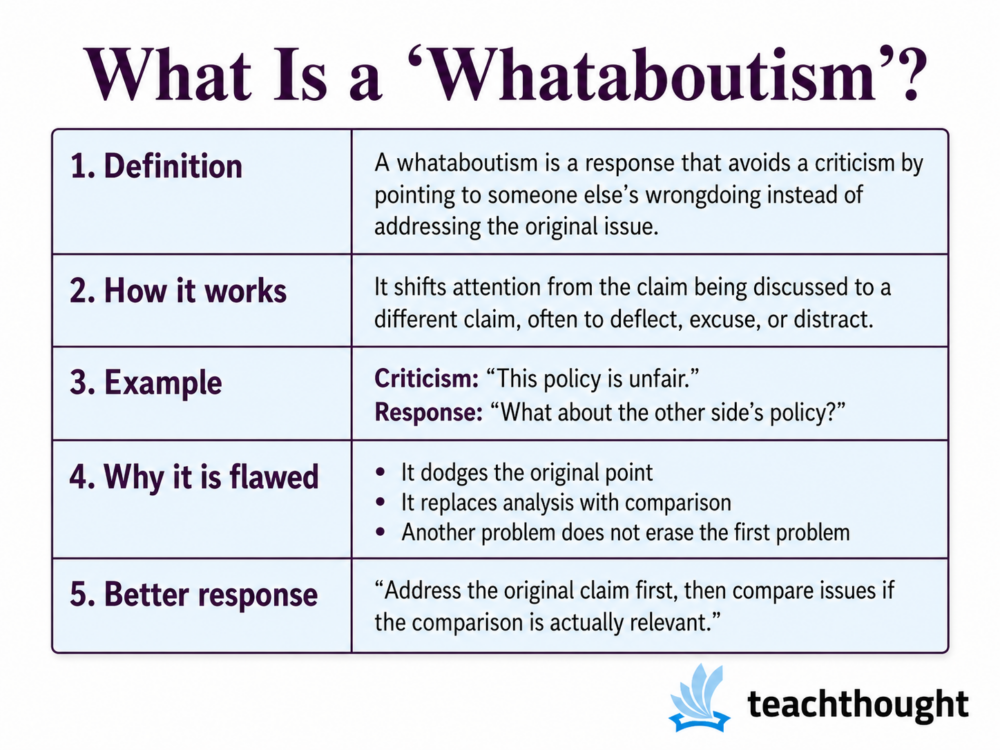
Whataboutism represents a common rhetorical strategy that derails productive dialogue by redirecting attention away from an original claim or criticism. Rather than engaging with the substance of an argument, a person using whataboutism responds with a counter-accusation or raises an unrelated problem, effectively saying "what about that issue instead?"
The tactic emerged prominently during Cold War discourse, when Soviet officials would deflect Western criticism about human rights violations by pointing to racial injustice in the United States. Today, whataboutism appears across political debates, social media arguments, and classroom discussions.
Educators benefit from teaching students to recognize whataboutism as a logical fallacy. When a student argues that dress codes are unfair because some teachers violate them too, they employ whataboutism. The teacher's conduct becomes irrelevant to whether the policy itself is reasonable.
TeachThought, an education platform focused on critical thinking skills, identifies whataboutism as a tool that prevents honest examination of problems. In polarized environments, the tactic flourishes because it satisfies those already aligned with a particular side while frustrating those seeking substantive debate.
Teachers increasingly incorporate fallacy identification into literacy and civics curricula. Students who understand whataboutism develop stronger argumentation skills and resist manipulation in political discourse. Schools from Massachusetts to California have added units on rhetorical devices and propaganda techniques to middle and high school English classes.
The strategy differs from relevant counter-arguments, which do address the core issue while offering alternative perspectives. A relevant response acknowledges the original claim, then adds context. Whataboutism simply changes the subject.
Media literacy instruction now treats whataboutism alongside other deflection techniques. Students analyze news coverage and social media posts to identify when commentators dodge questions or avoid accountability. This practice builds the analytical thinking required for informed citizenship.
Recognizing whataboutism