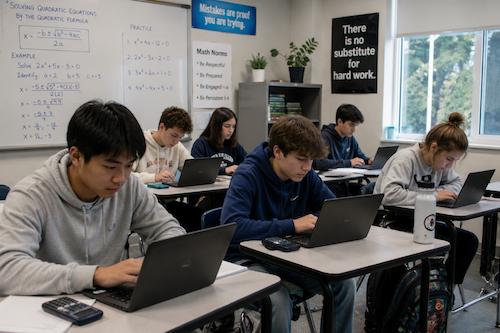
A new survey reveals that 68 percent of students turn to AI tools when they need extra help with math assignments and exams. The finding underscores how artificial intelligence has become embedded in student learning routines, particularly for high-performing math students.
The survey data shows AI functions as a tutoring supplement rather than a replacement for classroom instruction. Students report using AI tools to work through problem-solving steps, check their answers, and understand concepts they find challenging. This pattern reflects a shift in how students approach homework and test preparation.
The adoption rate among top-performing math students carries implications for schools and teachers. Educators must now contend with a student population that views AI as a standard resource, similar to calculators or textbooks. Some schools have begun integrating AI literacy into math curricula, teaching students how to use these tools responsibly. Others continue wrestling with whether AI use constitutes academic integrity violations.
The survey captures a moment of significant change in math education. Traditional policies around calculator use and homework help now seem antiquated when students have access to conversational AI that can explain algebraic concepts or guide them through multi-step problems. Schools face pressure to clarify expectations: when is AI use appropriate, and when does it cross into cheating?
Teachers report mixed reactions. Some view AI as a time-saver that frees them from repetitive explanations, allowing them to focus on deeper conceptual work. Others worry that students will use AI to bypass learning rather than enhance it. The distinction matters. A student who uses AI to understand why a solution works develops mathematical reasoning. A student who simply copies answers learns nothing.
The survey suggests students themselves recognize this distinction. High performers appear to use AI strategically as a learning aid, not a shortcut. This hints that with clear guidance, students can develop healthy relationships with AI tools in mathematics.
As AI integration accelerates, schools need explicit policies addressing when and how students