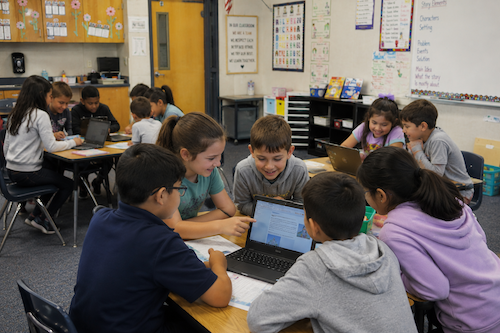
Project-based learning (PBL) approaches are reshaping how students engage with mathematics by grounding abstract concepts in real-world design challenges. Schools using PBL have students tackle practical problems—like designing functional backpacks—that require them to apply mathematical thinking to authentic tasks.
This method addresses a persistent challenge in math education: students often memorize procedures without understanding the underlying concepts. When students design a backpack, they encounter geometry through pattern layouts, measurements, and spatial reasoning. They use ratios and proportions to scale designs. They calculate material costs, invoicing arithmetic and budgeting into the project. The math becomes purposeful rather than abstract.
Early research on PBL in mathematics suggests students retain concepts more effectively when they've applied them to solve real problems. The approach also builds persistence. Unlike traditional worksheets where failure means a wrong answer, PBL projects allow students to iterate. A backpack design that doesn't work teaches students to revise their measurements and recalculate, turning mistakes into learning.
Elementary and middle school represent critical windows for building math foundations. Each concept scaffolds into the next, making conceptual understanding essential before moving to more advanced material. PBL advocates argue that students who truly grasp why a formula works develop stronger problem-solving skills than those who simply memorize it.
Teachers implementing PBL report increased student engagement and confidence in math. Students who initially resisted abstract mathematics often engage more readily when they see immediate applications. The approach also develops collaboration and communication skills alongside mathematical thinking.
However, PBL requires significant planning and professional development. Teachers must design projects aligned to standards while allowing student autonomy. Assessment shifts too. Teachers evaluate not just final answers but design thinking, iteration, and mathematical reasoning throughout the process.
Schools adopting PBL in mathematics report that students develop what educators call "math identity"—seeing themselves as capable math thinkers rather than