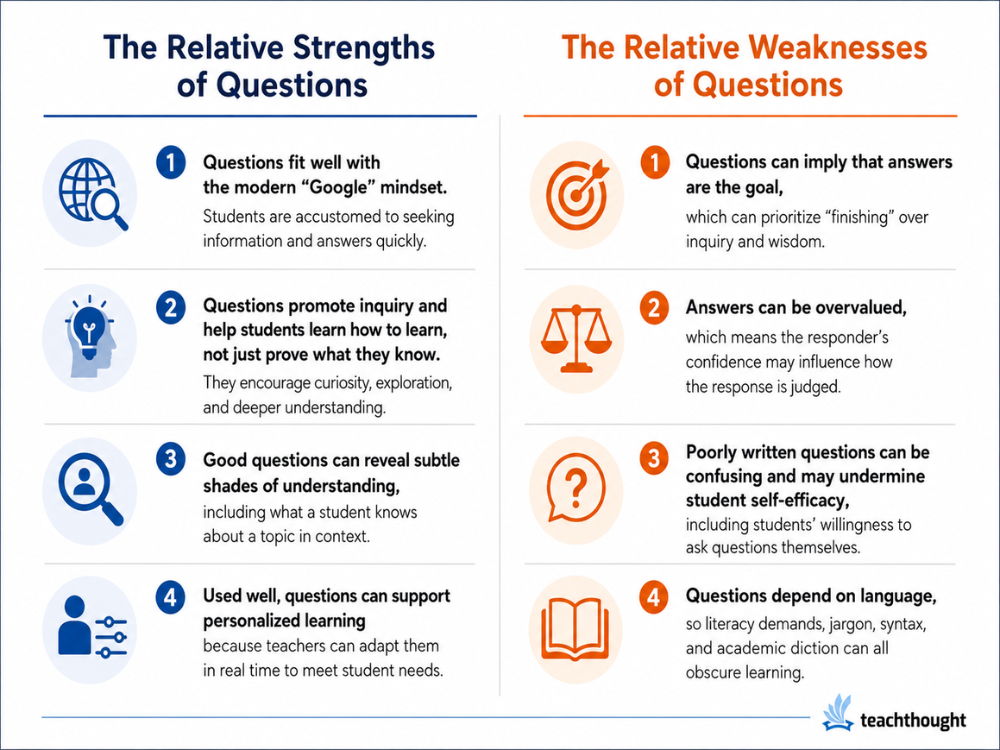
Asking questions in the classroom signals understanding rather than weakness. Teachers who recognize this distinction shift how they respond to student inquiry, creating space for deeper learning.
The guide reframes questioning as an intellectual strength. When students ask questions, they demonstrate awareness of gaps in their knowledge. This metacognitive skill—knowing what you don't know—forms the foundation for independent learning. Teachers who treat questions as evidence of thinking encourage more students to participate.
Classroom questioning operates on two levels. Students ask questions that reveal their learning edges. Teachers ask questions that push thinking forward. Both patterns matter. Student-generated questions often reveal misconceptions or areas needing clarification. Teacher-generated questions prompt analysis, comparison, and application of ideas.
The guide emphasizes question quality over quantity. A single well-crafted question that requires students to evaluate evidence outweighs five simple recall questions. Open-ended prompts that demand reasoning produce richer responses than yes-or-no queries. Questions phrased to elicit explanation help teachers understand student thinking and help students articulate their reasoning.
Timing affects questioning effectiveness. Questions posed during instruction allow teachers to adjust pacing and content. Questions at lesson's end assess learning. Questions distributed throughout a unit reinforce connections. Wait time also matters. Research shows students give longer, more thoughtful answers when teachers pause three to five seconds after asking a question.
Creating a classroom culture where questioning thrives requires deliberate choices. Teachers must respond to questions without judgment, validate attempts at reasoning even when incorrect, and model curiosity through their own questions. When students see questioning as valued behavior, they engage more openly.
TeachThought's guide provides teachers with concrete strategies for integrating questioning into daily practice. Rather than viewing questions as interruptions or signs of poor instruction, this approach positions them as windows into student thinking. Classrooms where questions flourish tend to produce more engaged, independent learners who take