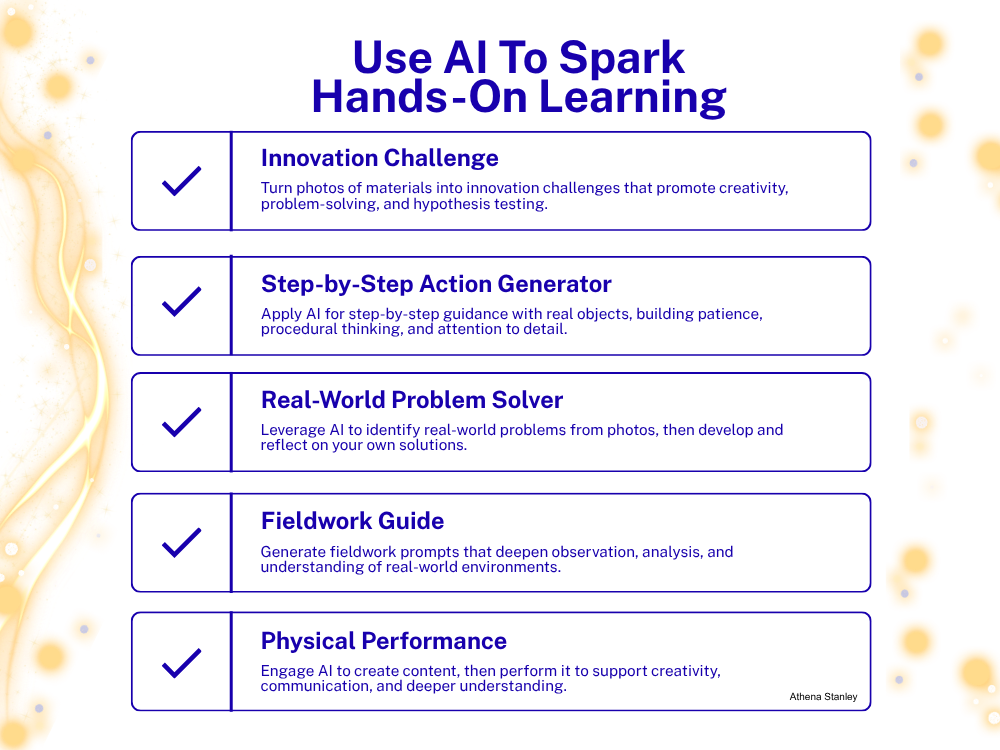
# From Screen To World: 5 Ways To Use AI To Spark Hands-On Learning In K–12 Classrooms
Teachers are integrating artificial intelligence into K-12 classrooms to bridge digital tools with tangible, real-world learning experiences. Rather than confining AI to screens, educators use it to prompt students to investigate their physical surroundings and develop problem-solving skills.
One practical approach involves having students photograph their environment—whether at school, home, or in their community—and ask AI to identify problems in that setting without providing solutions. This method pushes students beyond passive screen time. They become researchers who gather visual evidence, analyze what AI identifies, and then design their own interventions.
The strategy aligns with project-based and experiential learning models that emphasize student agency. Students move from observation to investigation to action. A student might photograph a poorly lit hallway and ask AI to flag safety concerns, then propose lighting improvements. Another might document erosion in a community garden and develop a restoration plan.
This approach also addresses concerns about AI replacing critical thinking. By asking AI to identify problems rather than solve them, teachers position the tool as a thinking partner, not a shortcut. Students retain ownership of the solution process.
Experts note that such implementation requires teacher training. Educators need guidance on prompt design, classroom management during field work, and integrating AI outputs into meaningful learning objectives. Professional development focused on these skills remains limited in many districts.
The model works across subjects. Science classes use it for environmental analysis. Social studies classes examine community infrastructure. Language arts students document and analyze community stories. This interdisciplinary potential makes AI integration flexible for different grade levels and curricula.
Schools piloting these methods report increased student engagement and deeper understanding of local issues. Students connect abstract problems to their own neighborhoods, making learning personally relevant.
Successful implementation depends on resources. Schools need working devices