# What Is Cognitive Dissonance?
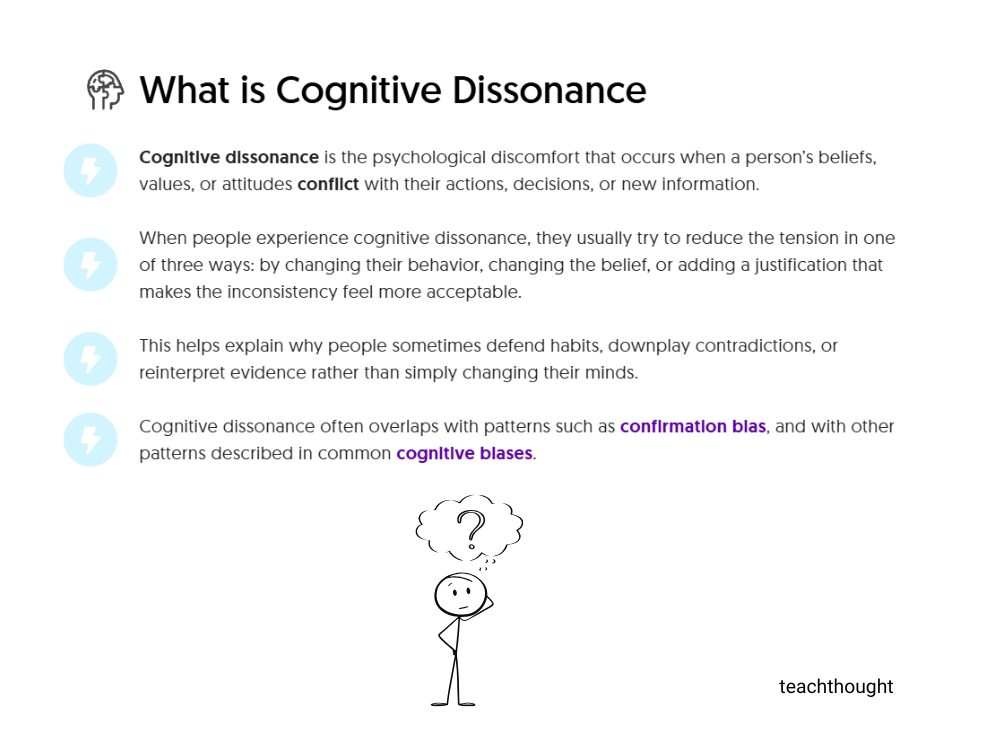
Cognitive dissonance describes the mental tension people experience when they hold contradictory beliefs, values, or attitudes simultaneously. This psychological concept appears regularly in classroom settings, where students often encounter information that conflicts with their existing worldview or prior knowledge.
Leon Festinger first formalized the theory in 1957, establishing that humans experience genuine discomfort when facing contradictions. This discomfort often motivates change. When a student learns evidence that contradicts their understanding, cognitive dissonance can trigger deeper thinking and revision of ideas. Teachers leverage this principle when designing lessons that deliberately challenge assumptions.
The phenomenon plays out differently depending on how significant the contradiction feels. A student might experience mild dissonance learning that a historical figure they admired held problematic views. Stronger dissonance occurs when core values clash with new information. A student passionate about environmental protection but accustomed to single-use plastics experiences sharper conflict than someone with no environmental commitments.
Three typical responses follow cognitive dissonance. Students might change their belief to match reality. They might reject the new information outright. Or they might rationalize both ideas simultaneously, finding ways to hold both without full integration. Educators recognize that how students resolve this tension determines learning outcomes.
Understanding cognitive dissonance helps teachers design better instruction. Rather than presenting facts that contradict student beliefs and moving on, effective educators acknowledge the discomfort, validate student thinking, and scaffold the process of belief revision. This prevents students from simply dismissing challenging information.
The concept also applies to teacher development. Professional development that contradicts classroom practices teachers have used successfully can trigger resistance. Recognizing this dynamic helps school leaders frame reform efforts as evolution rather than rejection of past work.
Cognitive dissonance remains a practical tool for understanding why students resist certain ideas, even when evidence supports them. Acknowledging this psychological reality shapes