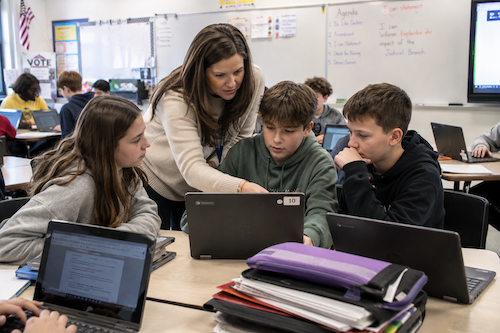
Illinois educators are developing statewide guidance for artificial intelligence use in schools, aiming to establish practical frameworks that reflect classroom realities rather than theoretical ideals.
Teach Plus Illinois, a teacher leadership organization, has spearheaded efforts to ensure that AI policy recommendations come directly from educators working in classrooms daily. The organization argues that statewide guidance must be grounded in what teachers actually experience with students, not disconnected from school operations.
The initiative centers three core principles. First, AI guidance should reflect genuine classroom contexts where students already use these tools for research, problem-solving, and creative projects. Second, policies should empower teacher leaders to make decisions about implementation in their own schools rather than imposing one-size-fits-all mandates. Third, frameworks must prioritize human connection and relationship-building as education's foundation, with AI serving as a tool rather than a replacement for instructor interaction.
Illinois recognizes that AI adoption is not a future concern but a present reality affecting how students learn. Students currently use AI tools to conduct research, develop solutions to problems, and complete creative assignments. Without clear guidance, schools face inconsistent practices across districts and individual classrooms. Some educators restrict AI use entirely, while others integrate it without safeguards around accuracy, bias, or academic integrity.
The Teach Plus Illinois approach differs from top-down policy creation. By centering teacher voices, the state can develop recommendations that educators will actually implement because they reflect practical possibilities and constraints. Teachers understand where AI adds genuine value, where it creates problems, and where it poses risks to learning outcomes or student development.
The effort acknowledges that policy makers often operate far from classroom floors. Teachers see daily how students interact with technology, where misconceptions emerge, and which applications support learning goals. This ground-level perspective prevents policies that look good on paper but fail in practice.
Illinois' focus on human connection responds to concerns that over-reliance