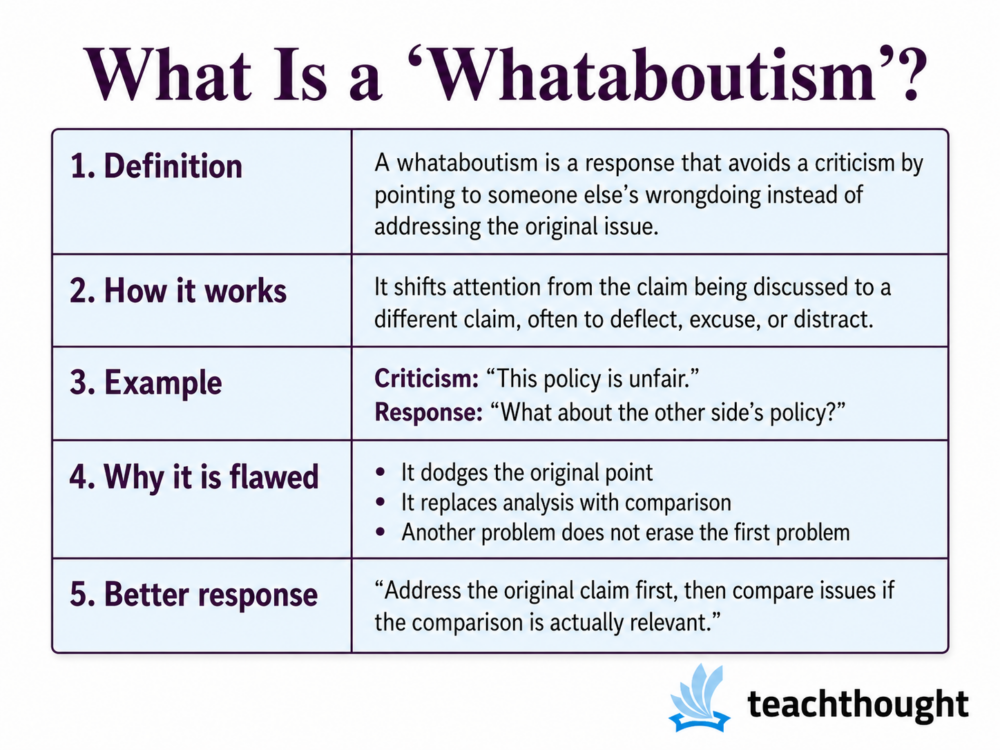
Whataboutism is a deflection tactic that sidesteps direct answers by redirecting attention to an unrelated or tangentially related issue, according to TeachThought. The term describes a rhetorical strategy where someone responds to criticism or a claim not with a counterargument, but with a tu quoque response, pointing out supposed hypocrisy or wrongdoing elsewhere.
In educational contexts, whataboutism appears regularly in classroom debates, policy discussions, and student discourse. When a teacher raises concerns about plagiarism, a student might respond with "But what about cheating on tests?" When administrators announce new discipline policies, critics deflect by asking "What about the lack of counseling resources?" These exchanges shift focus from the original issue without resolving it.
The tactic works because it exploits legitimate inconsistencies or problems that exist in parallel. It feels like a logical counterpoint but avoids engaging with the substance of the initial claim. Educators teaching media literacy and critical thinking skills increasingly address whataboutism as a cognitive bias and communication fallacy students encounter daily on social media and in political discourse.
Understanding whataboutism helps students distinguish between valid counterarguments and rhetorical evasion. A strong counterargument directly engages the claim being made. Whataboutism ignores it entirely. Teaching students to recognize this pattern strengthens their analytical skills and prepares them to evaluate arguments they encounter in news, debates, and online spaces.
The distinction matters for academic discourse. When writing essays, participating in Socratic seminars, or analyzing policy debates, students who recognize whataboutism can call out unfounded deflections and keep conversations focused on evidence and substance. This skill translates beyond school into civic participation, workplace communication, and informed citizenship.