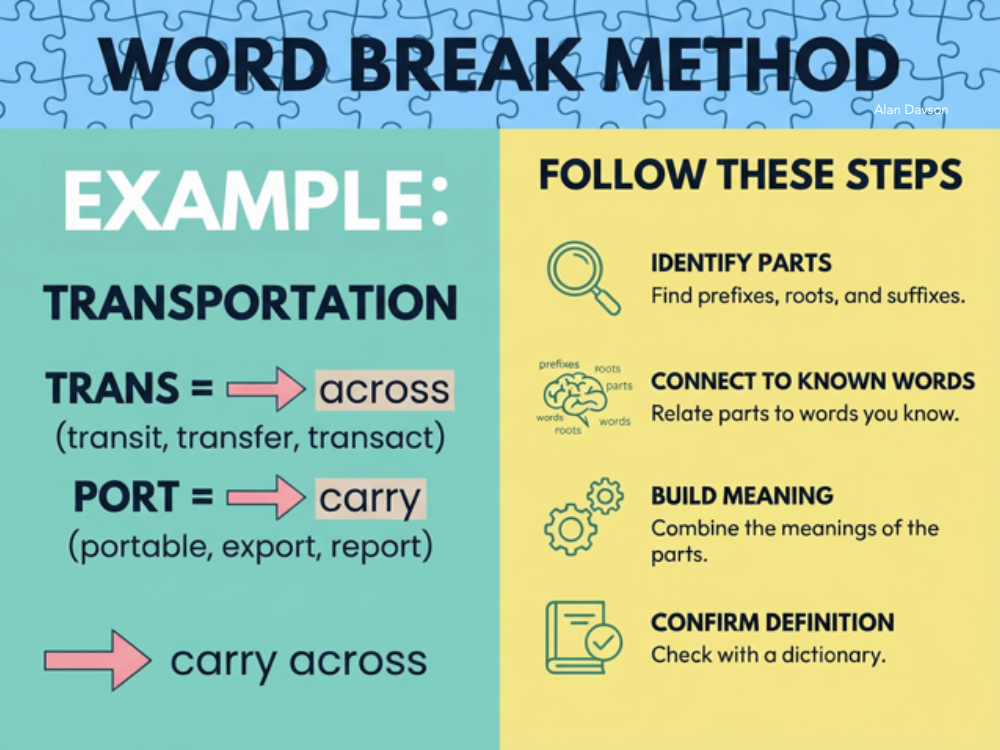
# How Breaking Words Changed the Way My Students Approach Language
A classroom teacher discovered that phonetic decoding alone does not build reading comprehension or vocabulary confidence. Students could mechanically sound out words but lacked the ability to extract meaning from them.
The teacher implemented a strategy of breaking words into component parts, morphemes, and etymological roots. This approach helped students understand not just how to pronounce words, but why words mean what they do. When students grasped that the prefix "un-" reverses a meaning or that "-tion" signals a noun, they began connecting patterns across unfamiliar vocabulary.
The practice proved especially effective for struggling readers. Rather than treating difficult words as isolated obstacles, students learned to deconstruct them. A word like "unhappiness" became manageable: "un" (not) plus "happy" plus "ness" (the state of being). This morphological awareness reduced anxiety and increased independence. Students no longer shut down when encountering unfamiliar terms.
The strategy also deepened engagement with texts. When students understood word structures, they read with more intention. They anticipated meaning before checking definitions. They made predictions about what similar-looking words might mean based on shared roots or affixes.
The teacher noted that this approach works across grade levels and content areas. Science students recognized Greek and Latin roots in technical vocabulary. History students understood how word origins reflected cultural and historical connections. Math students connected "tri-" to triangles and "polygon."
The shift from decoding-focused to morphology-focused instruction required rethinking lesson plans. Rather than assigning worksheets, the teacher built word study into reading and writing activities. Students began collecting words with shared roots or patterns, analyzing them in context, and using them in their own writing.
This method reflects research in linguistic science. Breaking words into meaningful parts activates multiple cognitive pathways. Students develop metalinguistic