# What U.S. and International Classrooms Can Teach Us About Improving Math Instruction
A student who executes complex equations perfectly but cannot explain why the method works reveals a central weakness in how American mathematics instruction often operates. This gap between procedural fluency and conceptual understanding has prompted educators to examine teaching practices across international classrooms for better approaches.
Research comparing U.S. math instruction with international models shows consistent patterns. American classrooms tend to emphasize procedural steps and memorization, while high-performing education systems in countries like Japan, Singapore, and Finland prioritize deep conceptual understanding first. Students in these systems learn not just how to solve problems but why solutions work.
The distinction matters for student outcomes. When students understand the reasoning behind mathematical procedures, they transfer that knowledge to new problems more effectively. They develop genuine problem-solving ability rather than reliance on rote memorization. International classrooms achieve this through deliberate instructional design that emphasizes reasoning before procedure.
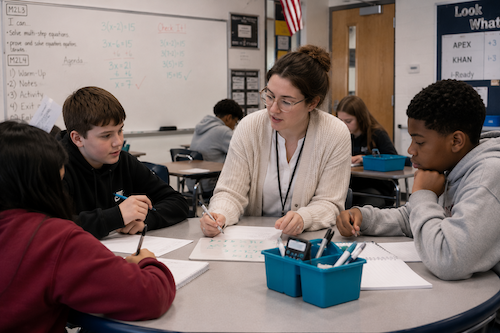
Several specific practices separate high-performing international systems from typical U.S. approaches. Teachers in top-performing nations use fewer problems per lesson but analyze each one thoroughly, discussing multiple solution strategies and asking students to justify their thinking. They build lessons around core mathematical ideas rather than disconnected procedures. Assessment focuses on explanation and reasoning, not just correct answers.
American educators adopting these practices report improvements. Teachers who slow down to build conceptual foundations find students later work through complex material more independently. Schools implementing reasoning-focused instruction see gains in both procedural fluency and problem-solving on standardized measures.
The shift requires rethinking teacher training and curriculum design. Teachers need support recognizing when students understand concepts versus merely mimicking procedures. Textbooks and pacing guides must allow time for depth over breadth. Professional development should focus on facilitating mathematical discourse rather than delivering content.
This year, when that same strong student encounters a new