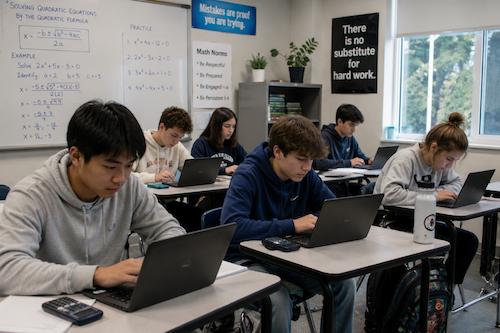
A new survey reveals that 68 percent of high-performing math students use AI tools to help with assignments and exams. The data suggests artificial intelligence functions as a legitimate study aid for a substantial portion of the student population tackling mathematics coursework.
The survey captures a shift in how students approach math learning. Rather than relying solely on textbooks, tutors, or peer study groups, nearly seven in ten top performers integrate AI into their academic toolkit. This adoption reflects broader acceptance of AI as an educational resource in secondary and higher education settings.
The finding raises questions about how schools should govern AI use in mathematics classrooms. Some educators worry that AI assistance blurs lines between learning and cheating. Others argue that using AI for math problem-solving mirrors real-world professional practice, where engineers and analysts routinely use computational tools. The distinction often hinges on whether students use AI to understand concepts or simply to obtain answers.
What remains unclear from the survey data is how students deploy these tools. Do they use AI to check work after solving problems independently? Do they ask chatbots to explain mathematical reasoning? Or do they rely on AI to generate solutions without working through problems themselves? These differences matter for learning outcomes. Research suggests that productive struggle with math problems strengthens conceptual understanding, while outsourcing problem-solving to AI may hinder retention.
Schools face pressure to establish clear policies around AI in mathematics education. Some institutions ban AI during assessments entirely. Others permit it as a tutoring resource but prohibit it during tests. A few forward-thinking districts treat AI as a legitimate learning tool and teach students to use it effectively, alongside traditional methods.
The survey's focus on top-performing students also deserves attention. These students may use AI differently than struggling learners. High achievers might leverage AI as a verification tool or for advanced exploration, while students with math anxiety might depend on it as a crutch, potentially limiting their