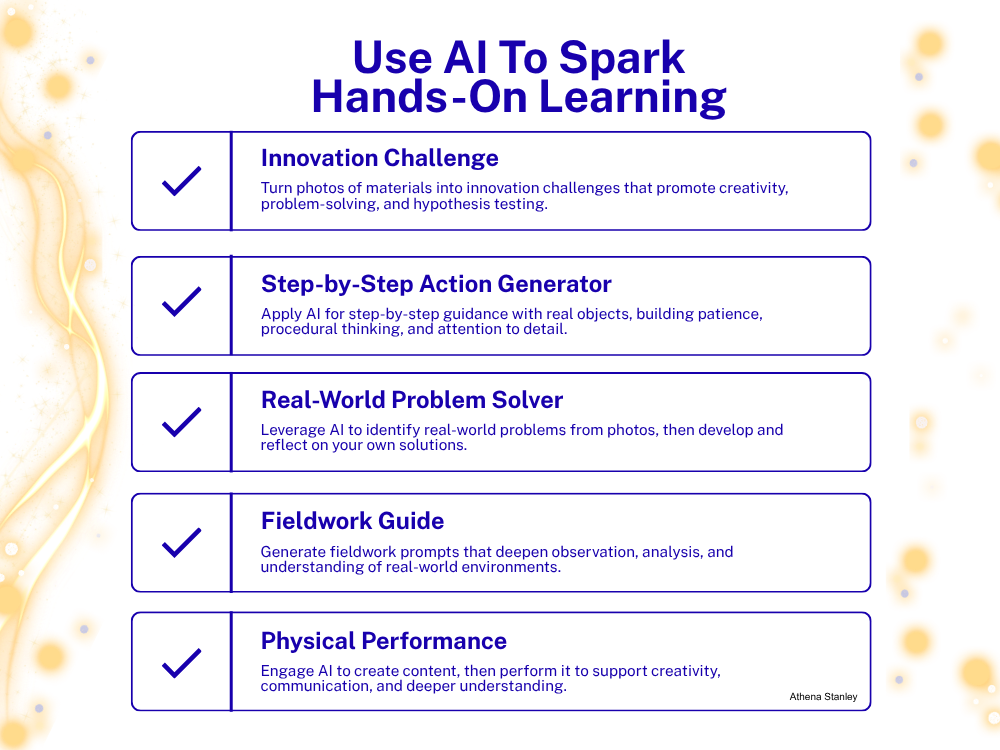
# From Screen to World: 5 Ways to Use AI to Spark Hands-On Learning in K–12 Classrooms
Teachers are finding practical ways to move artificial intelligence out of abstract territory and into real classrooms where students engage with tangible problems. One emerging strategy involves photography and environmental analysis. Students photograph their surroundings, then use AI tools to identify problems in those spaces without asking the system to solve them. This approach keeps the intellectual work on students' shoulders while leveraging AI as a diagnostic lens.
The method works across settings. A student might photograph a crowded hallway at school and ask an AI system what problems exist there, or examine a local park, their home, or a community street. The AI identifies issues, patterns, or inefficiencies without jumping to solutions. Students then move into the hands-on phase, designing and testing their own fixes.
This strategy aligns with project-based learning frameworks that have gained traction in K-12 education over the past decade. Rather than treating AI as a replacement for student thinking, teachers position it as a tool that surfaces questions worth investigating. The process mirrors real-world problem-solving, where identifying the problem often matters more than rushing to answers.
The approach also creates natural bridges between digital and physical learning. Students don't sit passively with screens. They move through their environments, observe carefully, and document what matters to them. The AI interaction becomes one step in a longer cycle that includes research, prototyping, testing, and iteration.
TeachThought's framework suggests this represents just one of five methods for integrating AI into hands-on learning. The emphasis across these approaches remains consistent: AI works best when it amplifies student agency rather than replacing it. Teachers retain control over learning objectives while students gain exposure to AI as a professional tool they might use in future careers.
Schools experimenting with these techniques report increased engagement when AI connects