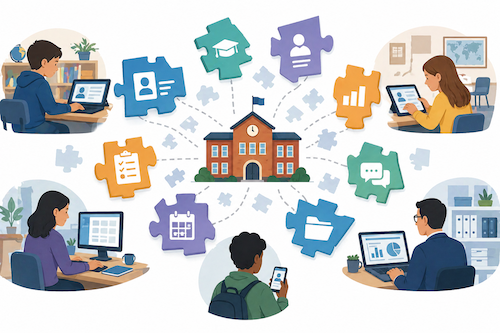
K-12 schools struggle with a hidden operational crisis: student data scattered across incompatible systems creates barriers to effective teaching and family engagement.
When schools use separate platforms for attendance, grades, special education records, discipline, and health information, educators and administrators waste time hunting for student information instead of using it to improve instruction. A teacher cannot quickly see that a student missed class yesterday and failed the last two assignments. A counselor cannot access complete data to identify students at risk of dropout. Parents receive inconsistent information about their child's progress from different staff members pulling from different databases.
This fragmentation wastes resources. Schools employ data coordinators and IT staff to manually transfer information between systems, duplicate data entry across platforms, and fix errors created by incompatible records. One missing piece of information can delay special education evaluations, prevent early intervention, or cause miscommunication during parent-teacher conferences.
The real cost emerges in student outcomes. When data lives in silos, schools miss patterns. A student showing signs of disengagement across multiple classes goes unnoticed because no one sees the complete picture. Schools cannot efficiently track which interventions actually work because data stays trapped in individual classrooms or departments.
The school-home connection suffers too. Parents expect real-time access to grades and attendance through parent portals, but fragmented systems mean delayed updates and conflicting information. Trust erodes when a parent sees conflicting data or receives the same communication twice from different staff members.
Districts attempting to solve this problem face real barriers. Legacy systems cost tens of thousands of dollars to maintain but cannot share data with newer platforms. Integrating systems requires expertise and budget many districts lack. Data privacy rules add complexity. Staff trained on one system resist switching to new tools.
Schools tackling fragmentation report faster response to struggling students, improved parent communication, and better resource allocation. The solution requires districts to audit existing systems, prioritize integration,