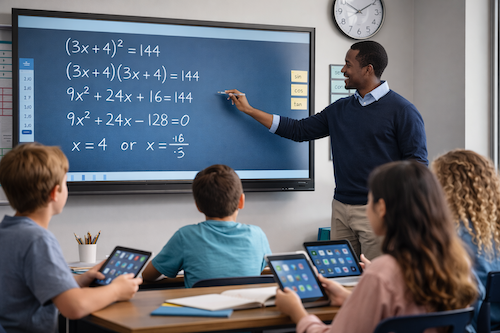
Schools must fundamentally redesign mathematics standards rather than relying on artificial intelligence to solve pedagogical problems, according to emerging consensus among education leaders.
The article argues that AI adoption in classrooms cannot salvage outdated teaching approaches. Technology cannot compensate for weak curriculum design or ineffective instruction methods. Districts pursuing AI-driven math solutions without first examining their underlying pedagogy risk embedding existing problems into new systems.
Math education faces mounting pressure to evolve. Student performance data shows persistent gaps in conceptual understanding, particularly in algebra and higher-level reasoning. Traditional curricula emphasize procedural fluency over problem-solving, pattern recognition, and mathematical thinking. These weaknesses exist independent of technology.
The real work requires educators to step back and ask fundamental questions: What mathematics do students actually need? Which skills matter most for college, careers, and civic participation? How should sequences build from elementary through secondary levels?
This reframing means rethinking what gets taught and how. Standards should emphasize modeling real-world situations, communicating mathematical reasoning, and understanding connections between concepts rather than memorizing procedures. Teachers need training aligned with these new expectations.
AI tools can support redesigned instruction. Adaptive platforms might provide personalized practice or identify where individual students struggle. But they work only when embedded in coherent curricula taught by educators who understand the subject deeply.
The path forward requires human expertise first. Mathematics specialists, curriculum designers, and classroom teachers must drive standards revision. They bring practical knowledge about what works in actual classrooms. Administrative and policy leaders must create time and resources for this work.
Districts implementing new math standards without sufficient teacher preparation or professional development will see limited gains. Implementation quality determines outcomes more than technological sophistication.
Schools still teaching high school mathematics from approaches designed decades ago cannot solve that problem through AI integration alone. Technology follows strategy, not the reverse. Building better math education starts with intentional redesign of what students learn and