# When STEM Lessons Are Too Easy, Students Stop Thinking
Students who encounter STEM lessons that are too simple disengage from the learning process entirely, according to analysis from TeachThought. The assumption that busy students are learning students overlooks a critical truth: low cognitive demand turns passive participation into mindless task completion.
When STEM curricula lack rigor, students shift into autopilot mode. They complete worksheets, follow procedures, and produce answers without developing deeper problem-solving skills. This pattern emerges particularly in mathematics and science classrooms where teachers prioritize completion rates over conceptual understanding.
The research points to a gap between engagement and cognitive load. A student can appear engaged while working on a low-demand task. They're not disruptive. They finish assignments. Teachers document participation. Yet nothing in their thinking stretches beyond surface-level comprehension.
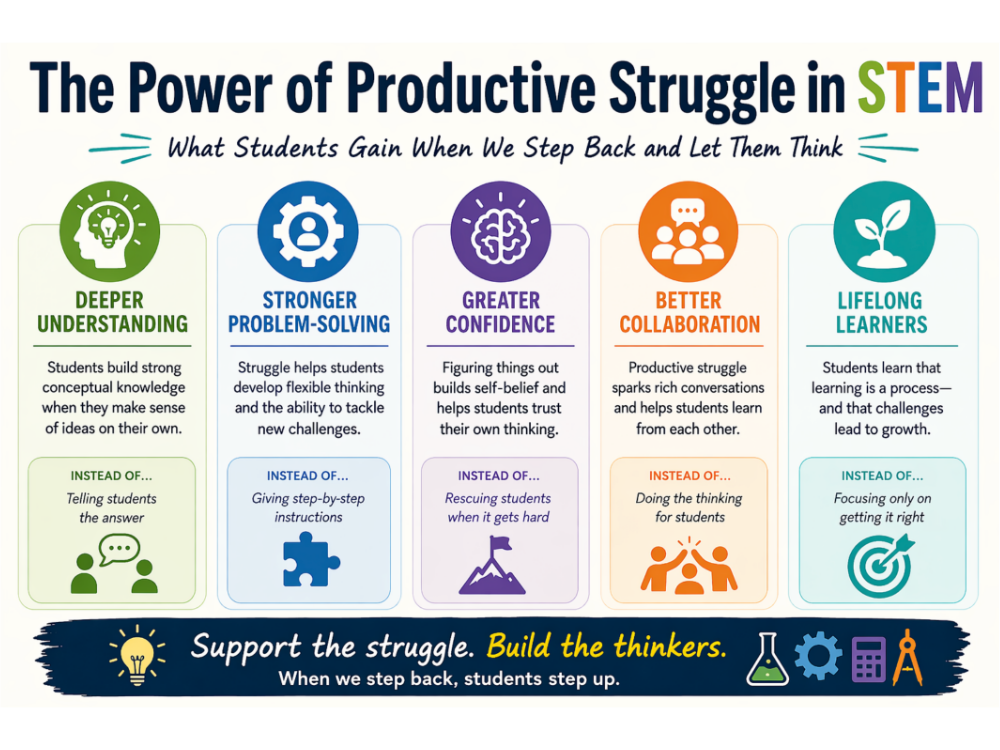
STEM instruction requires what researchers call "productive struggle." When problems demand genuine thinking, students activate higher-order reasoning. They test hypotheses. They revise strategies. They build mental models of how systems work. Low-complexity tasks eliminate these processes.
The challenge for educators involves calibrating difficulty precisely. Tasks that are too hard create frustration and avoidance. Tasks that are too easy breed complacency. The sweet spot exists when problems are hard enough to require thinking but accessible enough that students can make progress with effort and support.
This matters because STEM skills form the foundation for technology, engineering, and scientific literacy. Students who learn to think deeply in STEM classrooms develop habits of mind that transfer across subjects. They learn to approach unfamiliar problems systematically. They persist through obstacles.
Rethinking STEM lesson design means moving beyond the assumption that engagement equals learning. Teachers need to regularly assess whether their materials actually demand thinking. Are students solving problems or following recipes? Are they explaining their reasoning or just producing correct answers?