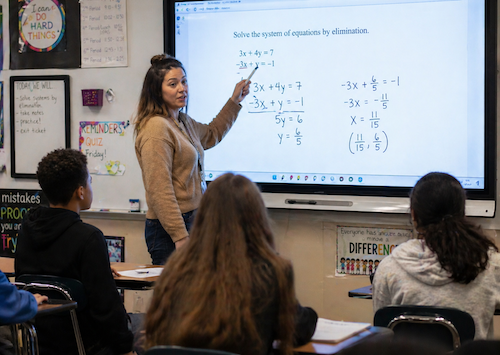
District leaders who want stronger math outcomes must prioritize building teacher confidence in the subject, not just student achievement metrics. A veteran high school math teacher's experience attending a professional learning session on early math instruction reveals why teacher mindset matters.
Teachers often attribute student math struggles to ability or effort gaps without examining their own pedagogical approaches. Professional learning that focuses on how students actually learn math, rather than drilling procedural skills, shifts teacher perspectives. When teachers understand the research behind conceptual learning and number sense development, confidence grows.
Four lessons emerge for district leaders implementing math improvement initiatives.
First, invest in deep professional development rather than one-shot workshops. Teachers need sustained engagement with math content and instructional strategies over time. Summer institutes, ongoing coaching, and collaborative planning sessions build competence that translates to classroom practice.
Second, create space for teachers to learn math differently than they experienced it. Many struggling math teachers learned through rote procedures rather than conceptual understanding. When districts model inquiry-based approaches during professional learning, teachers experience how these methods work. They develop firsthand confidence in alternative instructional models.
Third, build a culture where acknowledging knowledge gaps is safe. Teachers rarely admit math anxiety or uncertainty about content. Districts that normalize vulnerability and position professional learning as growth opportunity rather than remediation see better participation and outcomes.
Fourth, connect teacher confidence to student experience. As teacher confidence grows, classroom dynamics shift. Students perceive teacher certainty and enthusiasm. Math becomes less intimidating. The emotional tone of math instruction directly influences whether students see themselves as capable mathematicians.
Research shows that teacher content knowledge alone does not improve student learning. Teacher beliefs about mathematics, student potential, and their own ability to teach matter equally. Districts spending on curriculum materials without addressing teacher confidence waste resources. The high school math teacher's humility after 20 years in the classroom reflects a broader truth: improving math education requires helping teachers fundamentally rethink how they