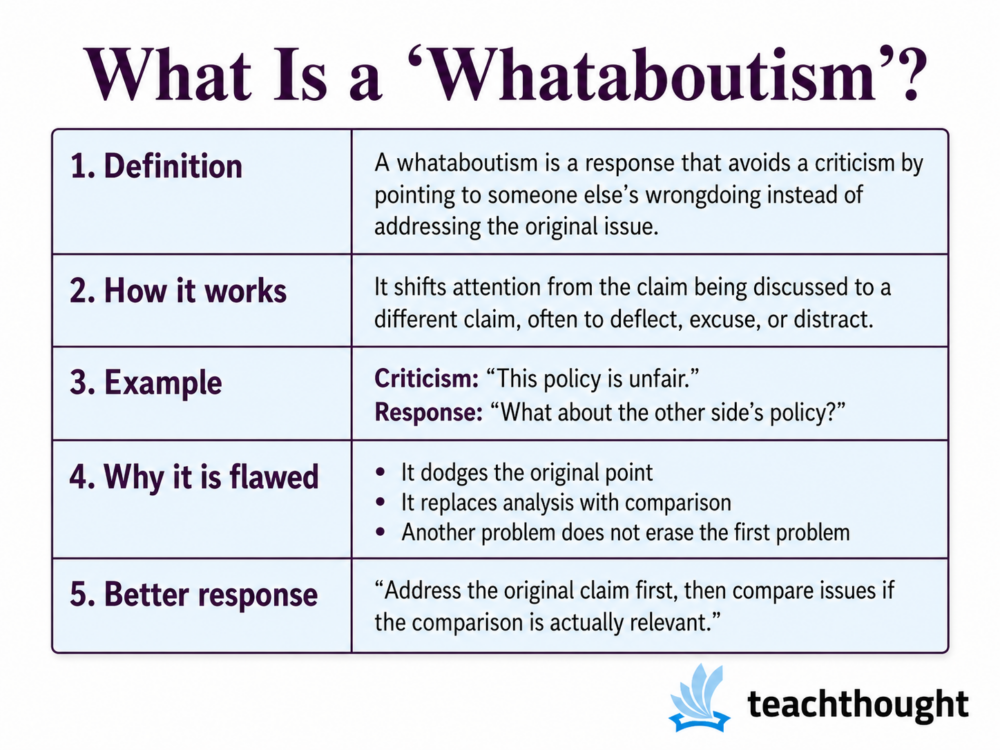
# What Is Whataboutism? A Guide for Students and Educators
Whataboutism functions as a rhetorical deflection that sidesteps direct engagement with a claim by redirecting attention elsewhere. Rather than addressing the original argument on its merits, a person employing whataboutism responds with "What about...?" followed by an unrelated or tangentially related issue.
This tactic appears frequently in classrooms, debates, and online discourse. A student accused of plagiarism might respond, "What about the student who copied homework last week?" A political figure questioned about a policy failure might counter, "What about the opposition party's similar failures?" In both cases, the speaker avoids the substantive claim by introducing a separate issue.
Understanding whataboutism matters for critical thinking. Students who recognize this pattern develop stronger analytical skills. They learn to evaluate arguments on their own terms rather than accept diversionary tactics. Teachers can help students identify whataboutism in historical debates, contemporary news coverage, and peer discussions.
The technique carries particular weight in polarized environments where audiences already favor one side. A sympathetic audience may accept the deflection without noticing that no actual rebuttal occurred. This makes media literacy essential. Students benefit from explicit instruction on how to spot whataboutism and respond with evidence-based counterarguments that stay focused on the original claim.
Educators teaching civics, debate, or writing courses can use whataboutism as a teaching tool. Students might analyze speeches or articles to identify instances of the technique. They can practice responding to whataboutism by restating the original claim and demanding a direct answer. Such exercises build the communication and reasoning skills students need for college, work, and informed citizenship.
Whataboutism differs from legitimate comparative analysis, which acknowledges and examines multiple related issues systematically. Teaching students this distinction prepares them to engage more effectively