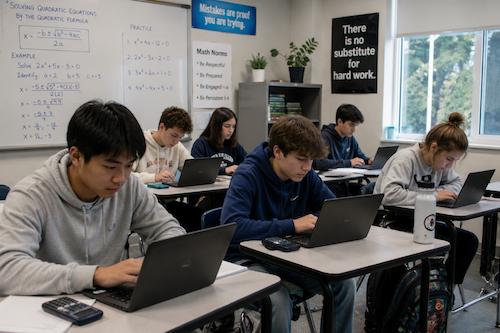
A new survey finds that 68 percent of high-performing math students rely on AI tools when tackling homework and exam preparation. The data points to a shift in how students approach mathematics instruction and independent learning.
The survey captures student behavior across a cohort of top performers. These students report using AI not as a replacement for traditional instruction but as a supplemental resource. The tools help them work through problem-solving steps, check their work, and access explanations when they get stuck.
The findings emerge at a moment of tension in education. Schools across the country are grappling with how to integrate generative AI into classrooms while maintaining academic integrity. Some districts have banned ChatGPT and similar platforms outright. Others are exploring guardrails that allow controlled use. The survey data suggests that students, particularly strong performers, have already incorporated these tools into their study routines regardless of official policy.
Math stands out as a domain where AI tools appear especially useful. Systems like ChatGPT can work through algebraic equations step by step, explain conceptual gaps, and generate similar practice problems. For students seeking immediate help outside school hours, these capabilities fill a gap that traditional tutoring cannot always address.
The survey does not address whether this use improves or harms long-term learning. Research on AI-assisted learning remains sparse, and questions persist about whether reliance on AI tools might undermine students' ability to develop problem-solving skills independently.
Educators now face a practical reality: students are using AI regardless of institutional policies. The data from strong performers suggests these students may be leveraging the technology strategically rather than treating it as a shortcut. Schools that ignore this trend risk disconnecting from student behavior and losing opportunities to teach responsible AI use.
Policymakers and administrators must decide whether to prohibit, regulate, or embrace these tools in mathematics education. The survey indicates that top students see value in AI support.