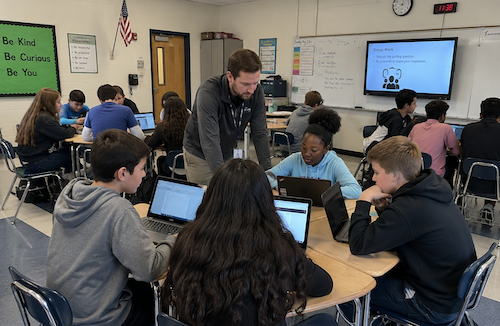
Teachers spend roughly 40 percent of their workday on assessment tasks like grading, data entry, and test administration. AI tools now automate these time-consuming processes, freeing educators to focus on instruction and student interaction.
Platforms using artificial intelligence can grade assignments instantly, flag struggling students for intervention, and organize performance data into actionable insights. Teachers receive real-time dashboards showing which students need help with specific concepts rather than spending hours manually reviewing papers and entering scores into spreadsheets.
The shift addresses a persistent problem in American schools. Teachers consistently report assessment burden as a top factor draining energy from their core work: planning lessons, providing feedback, and building relationships with students. When grading consumes 10 to 15 hours weekly, less time remains for the instructional preparation that research shows drives student growth.
AI assessment tools also generate detailed learning profiles. Instead of a single test score, teachers see patterns in how students approach problems, where misconceptions emerge, and what scaffolding individual learners need. This granularity enables differentiation at scale, allowing one teacher to personalize instruction for 30 students simultaneously.
Educators emphasize that AI serves as an assistant, not a replacement. The technology surfaces insights that spark deeper conversations between teachers and students about learning. A teacher might use AI-generated data to ask a student, "I noticed you struggled with fractions. Let's talk about what's confusing." That human interaction and follow-up teaching remain irreplaceable.
Concerns about overreliance persist. AI assessments cannot capture creativity, collaboration, or critical thinking the way human observation does. Some worry that over-automation erodes the pedagogical judgment teachers develop through experience. Schools implementing these tools report success when teachers retain control over what gets assessed and how AI outputs inform instruction rather than replace it.
Districts piloting AI grading report teachers reclaim 5 to 8