# From Screen to World: 5 Ways to Use AI to Spark Hands-On Learning in K–12 Classrooms
AI tools are moving beyond digital worksheets into tangible classroom practice. Teachers now embed artificial intelligence into real-world observation exercises that require students to move beyond screens and engage with their physical environment.
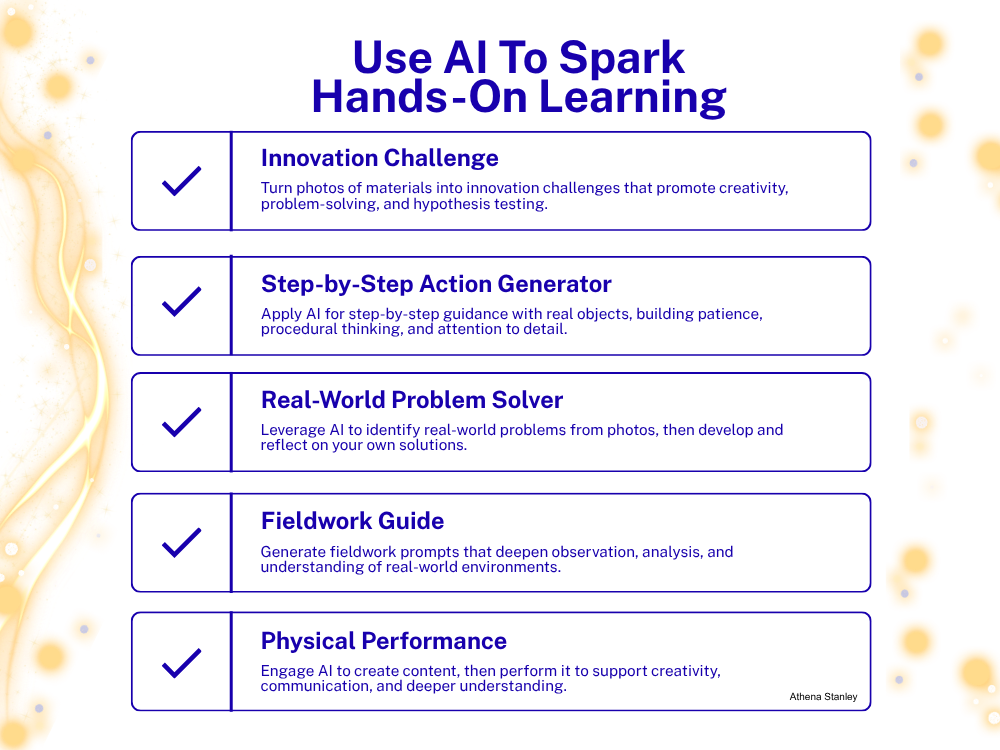
One approach involves photo-based problem identification. Students photograph their surroundings at school, home, or in their community, then ask AI systems to identify problems within those settings. The AI deliberately stops short of offering solutions, pushing students to develop their own answers. This structure forces active thinking rather than passive consumption of AI-generated responses.
The practice addresses a persistent classroom challenge: making abstract concepts concrete. When students photograph a neighborhood drainage issue or school playground design flaw, they connect learning to observable reality. They move from understanding problems theoretically to seeing them firsthand.
This method works across subject areas. Science students might photograph water quality issues and use AI to categorize environmental problems. Social studies classes could document community infrastructure gaps. Mathematics students might analyze spatial problems in real buildings. Each application keeps hands-on learning at the center while using AI as a thinking tool rather than an answer machine.
The approach also builds student agency. Rather than answering teacher-designed questions about predetermined scenarios, students choose what to investigate and what questions to ask. They own the learning process from observation through analysis.
Teachers implementing this strategy report that students stay more engaged when their work involves real places they know. A student photographing their actual neighborhood water runoff shows greater investment than working through a textbook scenario about the same topic.
The limitation remains clear: AI can identify problems but cannot replace human judgment about solutions. That boundary matters pedagogically. Students must grapple with trade-offs, community values, and practical constraints when solving real problems. AI handles pattern recognition and categorization. Students handle reasoning, creativity, and decision-