# An Updated Guide to Questioning in the Classroom
Teachers often treat student questions as interruptions or signs of confusion. TeachThought's updated guide reframes questioning as evidence of engagement and learning.
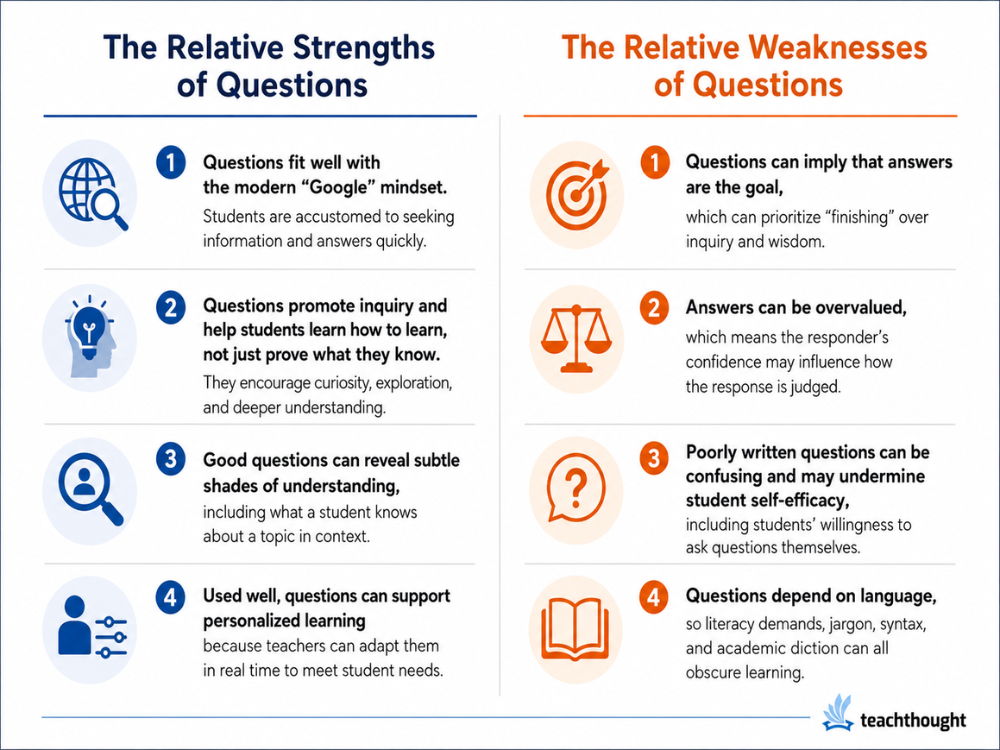
The guide positions questions as markers of understanding rather than gaps in knowledge. When students ask questions, they demonstrate active thinking. They identify what they don't know and seek to close that gap. This cognitive work separates passive listening from genuine learning.
The framework encourages educators to create classroom conditions where questioning feels safe and valued. Students who fear wrong answers rarely ask questions. Teachers who respond to queries with patience, follow-up prompts, and genuine curiosity build cultures where questions multiply.
The guide distinguishes between surface-level and deep questions. Surface questions check basic comprehension: "What year did this happen?" Deep questions push thinking forward: "Why might this have happened differently?" Both serve learning, but deep questions drive students toward analysis and synthesis.
Effective questioning practices also require teachers to ask better questions themselves. Rather than yes-no queries or recall prompts, teachers using this approach pose open-ended questions that require reasoning. "How do you know?" beats "Is that correct?" The first invites explanation. The second ends conversation.
The guide emphasizes timing and wait time. When teachers pause after asking a question, students have space to think. Five seconds of silence feels long in a classroom but gives more students opportunity to formulate responses. This practice particularly benefits slower processors and students learning in a second language.
Student questions also serve diagnostic purposes. A cluster of similar questions signals that instruction missed the mark. Rather than repeating the same explanation, teachers can adjust approach, use examples, or invite peer explanation.
TeachThought's resource aligns with research showing that classrooms with higher rates of student questioning produce stronger outcomes across content areas. Questions transform classrooms from information delivery systems into thinking partnerships between teachers and students.