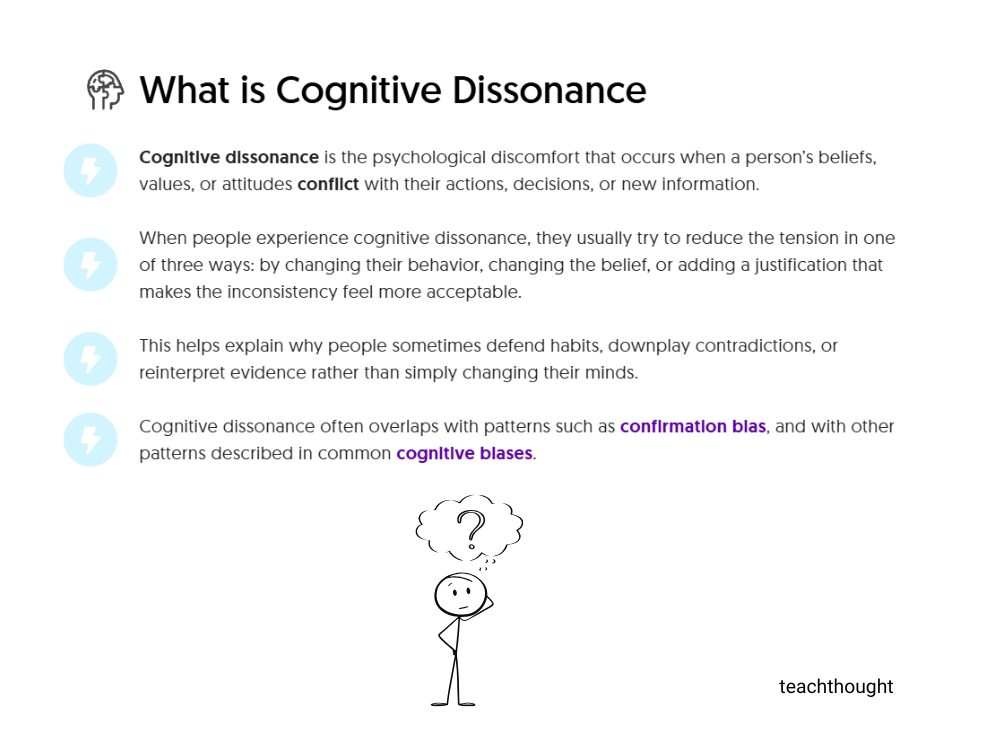
Cognitive dissonance describes the mental discomfort people experience when holding contradictory beliefs, values, or attitudes simultaneously. The concept applies directly to learning environments where students encounter information that conflicts with their existing worldviews.
In classrooms, cognitive dissonance becomes pedagogically valuable. When teachers present evidence that contradicts student assumptions, that discomfort can motivate learners to reconcile the conflict by updating their understanding. A student who believes climate change is insignificant but watches peer-reviewed data on rising temperatures experiences this tension. That discomfort often drives deeper thinking and knowledge revision.
Educators leverage cognitive dissonance intentionally. Socratic questioning, debate formats, and case studies that present opposing perspectives create productive conflict. Students must either defend their position with stronger evidence or adjust their beliefs. Research in learning science shows this struggle strengthens retention and critical thinking compared to passive information transfer.
However, cognitive dissonance can backfire. When the contradiction feels too extreme or threatening to identity, students sometimes reject new information entirely rather than change their thinking. A student whose cultural or familial values conflict with classroom content may experience defensive dissonance that closes rather than opens their mind. Skilled teaching requires presenting contradictions in ways that feel psychologically safe enough for students to sit with discomfort without shutting down.
The concept matters for teacher training and curriculum design. Effective instruction balances challenge with support. Introducing contradictions too aggressively alienates learners. Introducing them too gently wastes the learning opportunity. Teachers benefit from understanding that confusion and mild discomfort signal active learning, not instructional failure.
Parents also encounter this when children question family beliefs after learning new material at school. That tension is normal and often productive, though it requires patience from both sides.