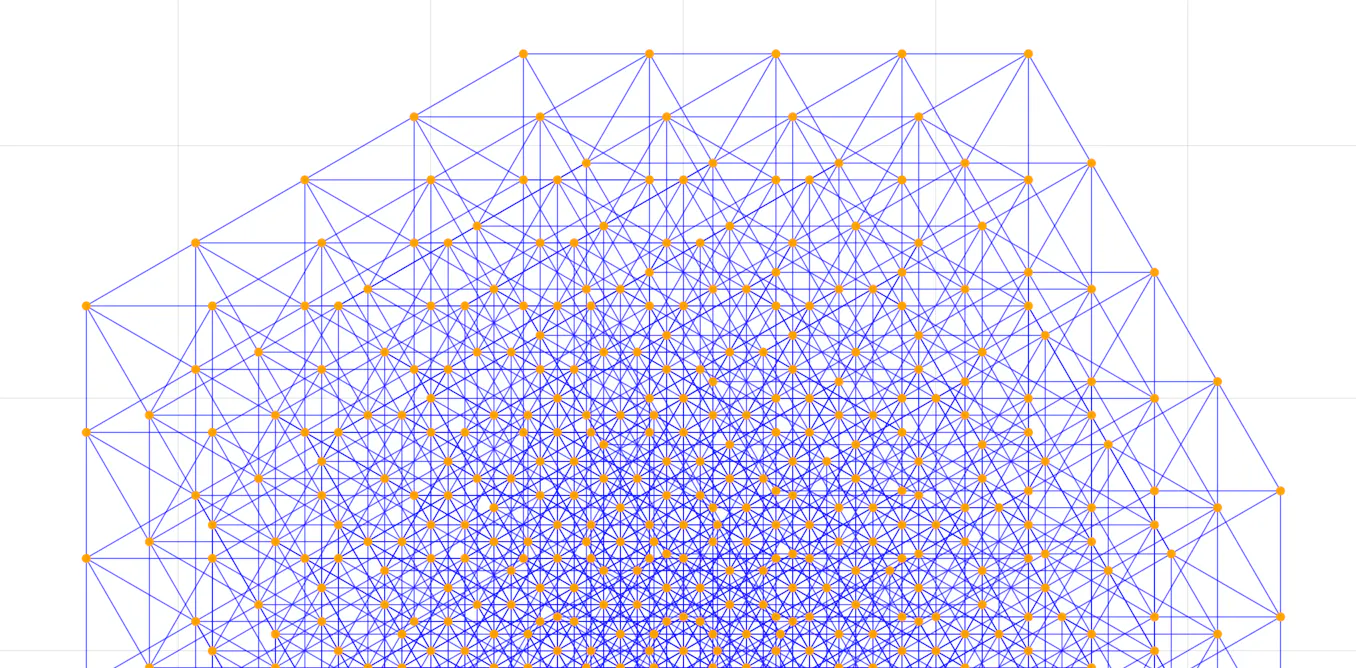
# AI Disproves 80-Year-Old Math Conjecture
An artificial intelligence system has refuted a foundational mathematics conjecture that Hungarian mathematician Paul Erdős posed in 1946. The "planar unit distance conjecture" had resisted human proof attempts for eight decades, but AI analysis has now demonstrated the conjecture false, forcing mathematicians to reconsider a central assumption in discrete geometry.
Erdős' conjecture stated that in any finite set of points in a plane where all points are equidistant from one another, the maximum number of such points follows a specific mathematical limit. This problem sat at the intersection of graph theory and geometry, with practical applications in network design and spatial optimization.
The AI breakthrough matters because it shows computational systems can tackle problems that have eluded human mathematicians despite sustained effort. Rather than performing brute-force calculations, the system identified patterns and structures that human researchers overlooked. This marks a shift in how mathematicians approach long-standing problems.
The discovery has sparked intense reaction within the mathematics community. Researchers now recognize they may need to rethink related theorems built on assumptions about the conjecture's truth. The refutation opens new research directions in discrete geometry and challenges which problems remain unsolved.
This case illustrates AI's expanding role in pure mathematics. Unlike applied fields, mathematics traditionally relied on human intuition and proof-construction. AI contributions here demonstrate that machines can augment mathematical reasoning by identifying patterns humans miss or by exhaustively checking cases humans cannot manually verify.
The result does not replace human mathematical thinking. Rather, it shows how algorithmic approaches and human creativity work together. Mathematicians must now understand why the conjecture fails and what replaces it. That interpretation work remains fundamentally human.
For educators and students, this development signals that mathematics itself is evolving. Fields once thought settled require revisiting when new tools emerge. It illust