# What U.S. and International Classrooms Teach About Math Instruction
A U.S. math teacher identified a troubling gap in student understanding. One of her strongest students could solve complex equations without error but faltered when asked to explain why the method works. This disconnect between procedural fluency and conceptual understanding reveals a persistent weakness in American math instruction.
Research from international classrooms demonstrates that high-performing countries teach math differently. In Japan, Singapore, and other top-performing nations, instruction prioritizes understanding before speed. Teachers spend time building conceptual foundations through problem-solving, discussion, and multiple solution strategies before students memorize procedures.
U.S. classrooms often reverse this order. Students learn procedures first, memorize steps, and practice repetitively. While this approach produces students who can execute algorithms quickly, many lack deep understanding of mathematical principles. When problems shift slightly or require explanation, these students struggle.
The TIMSS (Trends in International Mathematics and Science Study) assessments consistently show this pattern. American students perform adequately on routine computational tasks but lag on items requiring reasoning and application. Meanwhile, students from high-performing nations demonstrate both fluency and conceptual depth.
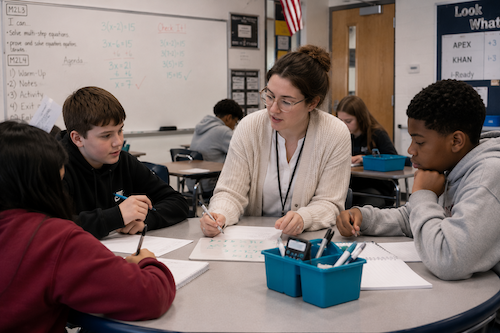
Classroom practices in top-performing countries emphasize mathematical discourse. Teachers pose open-ended questions, invite multiple solution methods, and guide students to explain their reasoning. This takes longer initially but builds stronger foundations. The approach also develops mathematical thinking, not just calculation skills.
Adopting these practices requires shifts in U.S. classrooms. Teachers need time to plan lessons that emphasize understanding. Curricula must reduce the pressure to cover excessive topics quickly. Assessment systems should value explanation and reasoning alongside correct answers.
The solution involves deliberate change. Schools implementing Japanese lesson study, Singapore's model method instruction, or similar approaches have seen gains in both conceptual understanding and achievement. When students can explain why a method works,