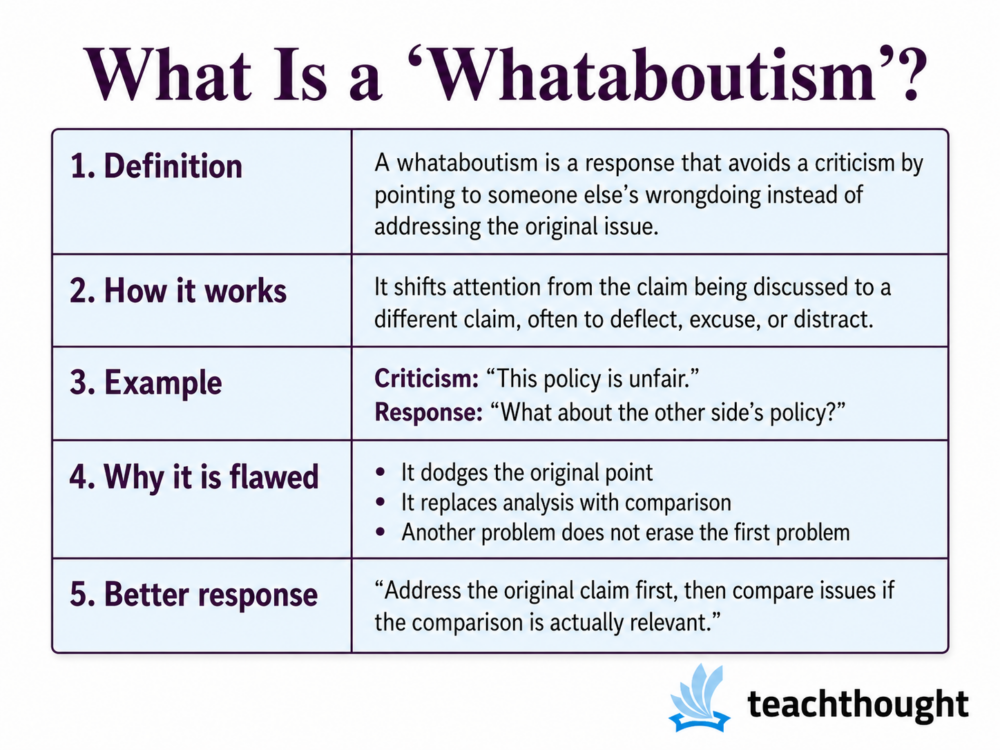
# What Is Whataboutism?
Whataboutism is a rhetorical tactic that deflects from an argument by redirecting attention elsewhere rather than addressing the original claim. The strategy works by responding to criticism or a question with a counterargument that shifts focus to an unrelated or tangentially related issue.
The term itself comes from the phrase "what about," which deflects responsibility. When someone uses whataboutism, they avoid defending their position or acknowledging a problem by introducing a different problem instead. This keeps the original discussion from reaching resolution.
In educational contexts, whataboutism appears frequently. A student might respond to feedback about missing homework by asking, "What about when you didn't grade our tests?" A school district might defend inadequate funding for special education by countering, "What about the money we spend on athletics?" A teacher might deflect from classroom management concerns by noting, "What about the students who misbehave in other classes?"
The tactic works because it creates false equivalence and derails productive dialogue. It shifts responsibility rather than accepting accountability. It muddies conversations that need clarity.
Recognizing whataboutism matters for students and educators. When learning to construct arguments, students benefit from understanding how this deflection weakens discourse. When evaluating claims, parents and educators should notice when whataboutism replaces actual reasoning.
Teaching students to identify whataboutism builds critical thinking skills. It helps them understand logical fallacies. It prepares them to construct stronger arguments and evaluate others' reasoning more carefully.
The antidote involves staying focused. Address the original claim first. Acknowledge the issue raised. Then, if a different concern exists, discuss it as a separate matter. This approach builds trust and moves conversations forward rather than spinning them in circles.